
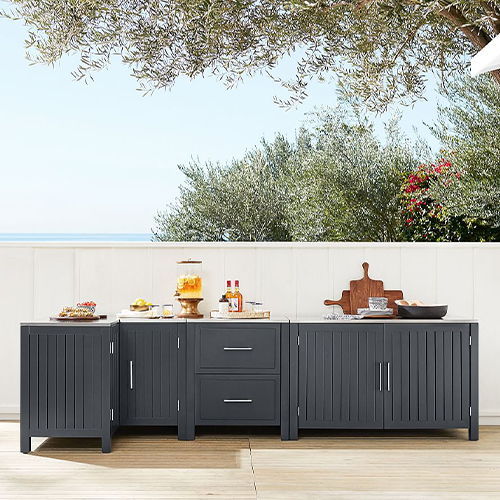
Aluminum vs Stainless Steel Outdoor Kitchen: Which Lasts?
Updated October 2026 · About a 8-minute read
Short answer: for most outdoor kitchens, powder-coated aluminum cabinets are the better choice. Aluminum can't rust, it weighs about a third as much as steel, and it doesn't show fingerprints or water spots. Stainless steel is the better material wherever there's direct heat or heavy cooking: grills, burners, grates and the parts of the island that touch them. And if you do go stainless near the sea, it needs to be 316, not 304.
That's why most well-built outdoor kitchens today use both: an aluminum island or cabinet run with stainless steel appliances dropped in. The rest of this guide explains where each metal wins, which grades and coatings actually matter, how both handle salt air, and what to pick for a backyard, a rooftop bar or a resort pool deck.
Aluminum vs Stainless Steel at a Glance
| Factor | Powder-coated aluminum | Stainless steel |
|---|---|---|
| Rust | Can't rust (no iron). Can oxidize white under damaged coating. | Rust-resistant, not rust-proof. 201 and 430 rust easily; 304 can tea-stain by the coast; 316 holds up best. |
| Salt air | Very good with a quality powder coat | Good in 316 with regular rinsing; 304 is risky |
| Heat from grills | Needs an insulated grill jacket and proper clearances | Handles direct heat well |
| Weight | About one-third of steel | Heavy; may need deck or roof reinforcement |
| Looks | Any color, matte textures, wood-grain finishes | Brushed metal, the classic "pro kitchen" look |
| Daily cleaning | Wipe and rinse; hides smudges | Shows fingerprints, water spots and streaks |
| Surface temperature in sun | Light colors stay fairly cool | Gets hot and reflective |
| Weak spot | Deep chips in the coating; dents in thin panels | Low grades, scratches, chlorides left on the surface |
| Best for | Cabinets, islands, coastal sites, rooftops, guest-facing areas | Grills, burners, grates, back-of-house cooking |
Is Stainless Steel or Aluminum Better for Outdoors?
It depends on what the metal has to do. Outdoors, the biggest enemy is moisture plus salt, and on that test aluminum has a built-in advantage: it contains no iron, so it physically can't produce red rust. When it's exposed to air, it forms a thin oxide layer that seals the surface. Put a good powder coat on top and you get a cabinet that can sit through years of rain, humidity and UV with very little attention.
Stainless steel protects itself in a similar way, using a chromium oxide layer. The difference is that chlorides (from sea spray, pool water or bleach-based cleaners) can break that layer in small spots. Once that happens, you get brown tea staining or pitting. Higher grades resist this much better than cheap ones, which is why "stainless" on a spec sheet doesn't tell you much until you know the grade.
Where stainless pulls ahead is heat and abuse. It keeps its strength at grill temperatures, takes knocks without denting and can be scrubbed hard. So the practical answer is: aluminum for the structure and the parts people see and touch, stainless for the parts that cook.
Not All Stainless Steel Is Equal: 201, 430, 304 and 316
Most complaints about "stainless steel outdoor kitchens rusting" come down to the grade. Here's what you'll run into:
| Grade | What it is | Outdoors |
|---|---|---|
| 201 | Low-nickel, budget grade | Rust spots appear quickly in humid or coastal air. Avoid. |
| 430 | Ferritic, no nickel, magnetic | Fine indoors, poor outside. Common on cheap grills and access doors. |
| 304 | The standard 18/8 grade | Good inland and on covered patios. Can tea-stain near the ocean or pools. |
| 316 | 304 plus 2–3% molybdenum | The one to use within a few miles of the coast. Still needs rinsing. |
A quick check you can do in a showroom: hold a magnet to the door or side panel. If it sticks firmly, it's probably a ferritic grade like 430. 304 and 316 are only very weakly magnetic, if at all. A magnet won't tell you 304 from 316, though, so for coastal jobs ask for the mill certificate or material spec in writing.
Thickness matters too. Stainless outdoor kitchen cabinets are usually sold by gauge, and 16 or 18 gauge (lower number = thicker) is what you want for doors and carcasses. Very thin 20–22 gauge panels dent and flex, and dents are where water sits.
Not All Aluminum Is Equal Either: Alloy, Thickness and Coating
"Aluminum outdoor kitchen" covers everything from flimsy sheet cabinets to heavy, welded frames. Three things separate them.
Alloy
You'll mostly see three families. 6063 is the architectural extrusion alloy used for window frames, curtain walls and outdoor furniture. It has good natural corrosion resistance and takes powder coating well. 3003 is a sheet alloy often used for cabinet panels. 5052 and 5083 are the true marine alloys used in boat hulls. Any of them can make a good outdoor kitchen; what matters more is that the supplier tells you which alloy and how thick, rather than just "aluminum".
Wall and panel thickness
Thin aluminum dents and can sag under a stone countertop. Ask for the frame profile wall thickness and the panel thickness, and ask how the frame carries the countertop weight. A double-layer or reinforced frame spreads the load and keeps doors aligned over time.
Powder coating
The coating is what makes or breaks an aluminum kitchen by the sea. Good powder coating starts with proper pretreatment (cleaning and conversion coating) so the powder actually bonds, then an outdoor-grade powder applied at a decent thickness. Architectural specs to look for are AAMA 2604 (tested through 5 years of Florida exposure) or AAMA 2605 (10 years), or a Qualicoat class rating. Branded powders such as TIGER Drylac from Austria are formulated for high UV and salt exposure. A cheap coating chalks, fades and, once chipped, lets white oxidation creep underneath.
If you want more background on why powder-coated aluminum works so well outside, see aluminum outdoor furniture: essential properties and care.
Which Is Best for Coastal and Humid Climates?
For an outdoor kitchen within a few miles of salt water, or next to a pool, the safest combination is powder-coated aluminum cabinets with 316 stainless appliances and hardware. Aluminum cabinets don't care about salt spray as long as the coating is intact. 316 stainless holds up far better than 304 against chlorides, though it still needs rinsing.
What tends to fail first by the sea:
304 or 430 access doors and drawer fronts, which show tea staining after one or two seasons.
Cheap hinges, screws and drawer slides, even on otherwise good cabinets. Rust from a zinc-plated screw can stain the coating around it.
Chips in thin powder coating, especially at corners and toe kicks where mops and feet hit.
Trapped water. Cabinets without drainage or ventilation stay damp inside, which leads to mold and corrosion of whatever is stored there.
How to maintain powder-coated aluminum islands by the coast
You don't need special products. A pH-neutral soap (car wash soap works well), a soft cloth or sponge and a freshwater rinse every two to four weeks is enough, plus after storms or windy days. Once or twice a year, a coat of non-abrasive automotive wax helps water and salt bead off. Avoid scouring pads, solvents, acetone and strong alkaline cleaners, which dull or soften the coating. If you spot a chip, clean it and seal it with matching touch-up paint before moisture gets under the edge.
How to keep stainless steel from tea staining
Rinse with fresh water often, dry it if you can, and clean in the direction of the grain with a stainless steel cleaner. If light brown staining appears, a citric- or phosphoric-acid stainless cleaner usually removes it and helps restore the passive layer. Never use bleach or chlorine-based cleaners on stainless, and keep pool chemicals stored away from the kitchen.
Grill Heat, Burners and Pizza Ovens
This is where stainless steel earns its place. Aluminum melts at around 660°C (1220°F), compared with roughly 1400°C for stainless, and aluminum alloys lose strength well before that. It also conducts heat many times faster than stainless, so a hot grill box can warm the cabinet around it.
None of that rules out aluminum islands. It means the island needs to be designed for the appliance:
Use an insulated grill jacket (usually stainless) wherever the grill maker requires one, and follow their clearance specs.
Leave ventilation openings for gas appliances so heat and any leaked gas can escape.
Choose a heat-tolerant countertop around the grill, such as sintered stone or GRC, and use trivets for hot pans.
Keep pizza ovens and charcoal grills on their own stand or a dedicated masonry or stainless module.
For a broader look at layout, zones and utility runs, our guide on how to build an outdoor kitchen walks through the planning step by step.
Weight and Installation
Stainless steel is roughly three times as dense as aluminum. For an 8- to 10-foot island with a stone top, that difference can mean a few hundred pounds, which matters on a timber deck, a balcony or a hotel rooftop with load limits. It also means more people on installation day and higher freight costs.
Aluminum modules can usually be carried into place by two people, leveled on adjustable feet and joined on site. That's a big part of why aluminum has taken over on rooftop bars, terraces and pool decks. If you need something that moves, a mobile aluminum kitchen cabinet on casters is an option stainless rarely makes practical.
Looks, Cleaning and Day-to-Day Use
Stainless gives you the commercial-kitchen look, and some people want exactly that. The downside is that every fingerprint, drip and water spot shows, and in strong sun it reflects glare and gets hot to touch.
Powder-coated aluminum comes in almost any color, from matte black and warm grays to wood-grain finishes, so the kitchen can match the house, the patio furniture or a hotel's brand palette. Matte textures hide smudges, and light colors stay cooler in summer. Day to day, a wipe with a damp cloth is usually all it needs.
Cost and Long-Term Value
Price depends more on grade and build quality than on the metal itself. Thin 201 or 430 stainless islands are the cheapest thing you can buy, and usually the first to rust. Good 304 stainless and well-built powder-coated aluminum sit in a similar mid-to-upper price band. 316 stainless is the most expensive.
Over the life of the kitchen, aluminum often comes out ahead: lower freight and installation costs, no rust repairs, and a finish that can be recoated if you ever want a new color. Stainless can last just as long, but in coastal or pool settings only if you pay for 316 and keep up the rinsing.
Other Outdoor Kitchen Materials Worth Knowing
Concrete, block or stone masonry: extremely durable and fireproof, great around built-in grills and pizza ovens. Heavy, permanent and slow to build, and you still need doors and drawers, usually in stainless.
HDPE (marine polymer): won't rot or rust and is easy to clean, but it's heat-sensitive, so grills need insulated jackets. It can also fade without UV inhibitors.
Teak: warm and natural looking, and very weather-resistant for a wood. Needs occasional oiling if you want to keep the honey color, and must be kept away from direct heat.
Countertops deserve their own decision. Sintered stone, granite and GRC all handle UV and rain; we explain why GRC is popular on aluminum islands in what makes GRC countertops ideal for outdoor kitchens.
Can You Mix Aluminum and Stainless Steel?
Yes, and most good outdoor kitchens do. There's one technical detail to get right: galvanic corrosion. When aluminum and stainless steel touch in the presence of salt water, the aluminum acts as the sacrificial metal and corrodes at the contact point. In practice this shows up around stainless screws driven into bare aluminum, or a stainless grill sitting directly on an uncoated aluminum frame.
The fix is simple. Keep the powder coat intact at contact points, use nylon or rubber isolation washers and bushings under stainless fasteners, and seal cut edges. A manufacturer who builds mixed kitchens regularly will already do this; it's worth asking.
Design Details That Decide How Long an Outdoor Kitchen Lasts
Whatever metal you choose, these details matter as much as the material:
Material thickness: panel gauge or wall thickness, in writing.
Coating spec: pretreatment, powder brand and a salt-spray or weathering test report (ASTM B117 salt spray hours, AAMA 2604/2605 or Qualicoat).
Joints and seams: welded or tightly sealed seams keep water out of the frame. Open seams trap moisture.
Drainage and ventilation: weep holes, slatted or vented doors, and raised feet so water doesn't pool inside or under the cabinet.
Hardware: 304 or 316 stainless hinges, slides and screws, with soft-close slides rated for outdoor use.
Countertop support: a frame designed to carry stone weight without sagging.
We go deeper into keeping water out in our article on waterproof outdoor kitchen cabinets.
Which Should You Choose? Recommendations by Project
| Situation | Best choice | Why |
|---|---|---|
| Inland backyard, covered patio | Either; 304 stainless or aluminum | Low corrosion risk, so pick on looks and budget |
| Beach house, coastal villa | Aluminum cabinets + 316 appliances | No rust on the structure; 316 where heat is needed |
| Pool deck | Aluminum + 316 hardware | Chlorine splash attacks lower grades of stainless |
| Rooftop bar, hotel terrace, balcony | Modular aluminum | Light enough for load limits and lifts; easy to install |
| Resort or beach club, guest-facing | Powder-coated aluminum in brand colors | Looks clean between services, matches the furniture |
| Restaurant back-of-house, heavy cooking | 304 or 316 stainless | Takes high heat, hard scrubbing and health-code cleaning |
What hotels and resorts usually specify
On hospitality projects, the outdoor kitchen is usually part of the guest experience: a show-cooking station by the pool, a grill bar on a rooftop, a villa terrace with its own island. Those spaces need to look good after every service, survive daily cleaning and match the surrounding seating. That's why most resort and hotel buyers now go with modular powder-coated aluminum, with stainless appliances and 316 hardware. Pre-assembled modules also cut installation time on site, which matters when a terrace has to reopen quickly. If you're planning one, our look at commercial outdoor kitchen design trends covers layouts that work for hotels and restaurants, and counter seating is easier to plan with our bar height vs counter height stool guide.
The Same Question for Outdoor Furniture Frames
Buyers often ask the same thing about chairs, sofas and dining sets: powder-coated aluminum or stainless steel frames? The logic is similar. Aluminum is lighter to move and stack, can't rust and comes in any color. Stainless (316 for coastal use) is heavier and more stable in wind, but it gets hot in the sun, shows water spots and costs more. For most hotel terraces and patios, aluminum frames win; stainless makes sense for windy rooftops or a polished, minimalist look. We cover this in more detail in the benefits of powder-coated aluminum for outdoor furniture.
How Kingmake Outdoor Builds Aluminum Outdoor Kitchens
Kingmake Outdoor is an outdoor furniture manufacturer based in Foshan, China. Since 2008 we've supplied hotels, resorts, villas, distributors and contractors from our own 18,000 m² factory, and our aluminum outdoor kitchens are built along the same lines as the advice above:
Frames: 6063 aluminum with a double-layer structure that carries a stone countertop without sagging.
Coating: standard outdoor powder coat, or TIGER powder coat (Austria) for coastal and high-UV sites, in 18 colors including wood-grain finishes.
Countertops: GRC or sintered stone, with quartz and other engineered stone available on request.
Moisture control: ventilated slats, weather-sealed joints and CNC-cut parts so doors and panels stay aligned.
Hardware and modules: stainless steel fittings, soft-close drawers, shelving, and cut-outs for grills, sinks and refrigeration.
Warranty: up to 5 years on structure and finish with the TIGER coating option.
The KMO1301 aluminum outdoor kitchen is a good example: a modular run with a GRC top and open compartments for large equipment, made for resort terraces and coastal villas. For extra storage, the KMO1304 storage cabinet adds closed space beside the cooking zone. Standard modules come in straight, L-shaped and U-shaped layouts, and we can change sizes, finishes, countertops and appliance cut-outs through our customization service, with 3D layout drawings before production. Typical lead time is around 30 days, depending on the order.
Because the kitchens come from the same factory as our dining sets, bar stools and lounge seating, a whole terrace can be specified in one coordinated color and finish. You can see how that works on real projects on our hotel outdoor furniture supplier page.
Questions to Ask Any Outdoor Kitchen Supplier
Which aluminum alloy or stainless grade is used for the frame, doors and panels? Can you put it in writing?
What's the panel gauge or frame wall thickness?
What powder brand and pretreatment do you use? Is there a salt-spray or weathering test report?
Are hinges, slides and screws 304 or 316 stainless? How are stainless parts isolated from aluminum?
Which grills and appliances are the cut-outs designed for, and is an insulated jacket included?
How do the cabinets drain and ventilate?
What does the warranty cover: structure, finish, countertop, hardware? For how long?
For commercial orders: lead time, packing, and whether spare doors or panels can be supplied in the same color later.
FAQs
Is aluminum or stainless steel better for an outdoor kitchen?
For cabinets and islands, powder-coated aluminum is usually better: it can't rust, it's lighter and it's easier to keep clean. Stainless steel is better for grills, burners and other parts exposed to direct heat. Most quality outdoor kitchens combine the two.
Is stainless steel or aluminum better for outdoor use in general?
For anything exposed to rain, humidity or salt air, powder-coated aluminum is lower maintenance because it contains no iron and can't rust. Stainless steel is stronger, more heat-resistant and harder to dent, but only grade 316 handles salt air well.
Does a stainless steel outdoor kitchen rust?
It can. Grades 201 and 430 rust easily outdoors, and 304 can develop brown tea staining near the ocean or a pool. 316 resists chlorides much better, but it still needs regular freshwater rinsing.
What is the best outdoor kitchen material for coastal areas?
Powder-coated aluminum cabinets with 316 stainless appliances and hardware. Ask for an outdoor-grade powder coat (AAMA 2604/2605, Qualicoat or a branded powder such as TIGER) and isolate stainless fasteners from the aluminum.
Can an aluminum outdoor kitchen handle a built-in grill?
Yes, if it's designed for it. Use an insulated grill jacket where the grill maker requires one, follow the clearance specs, add ventilation for gas, and choose a heat-tolerant countertop around the grill.
How do you clean powder-coated aluminum outdoor kitchen cabinets?
Wash with pH-neutral soap and water, rinse with fresh water every few weeks (more often by the coast), and apply a non-abrasive car wax once or twice a year. Avoid scouring pads, solvents and harsh alkaline cleaners.
Is 304 stainless steel good enough for an outdoor kitchen?
Inland and under cover, yes. Within a few miles of salt water, next to a pool or in very humid climates, 316 is the safer choice, or aluminum cabinets with 316 only where it's needed.
Which is cheaper, an aluminum or a stainless steel outdoor kitchen?
Budget stainless (201/430) is cheapest up front but rusts. Quality powder-coated aluminum and 304 stainless cost about the same, and 316 costs the most. Aluminum usually saves on freight, installation and long-term repairs.
Are aluminum outdoor kitchens suitable for hotels and resorts?
Yes. They're light enough for rooftops and terraces, resist salt air and pool chemicals, come in brand colors and install quickly in modules, which is why many hotels and resorts now specify them for guest-facing cooking areas.
 Whatsapp
 sales@cnkingmake.com
 +8613925925021