
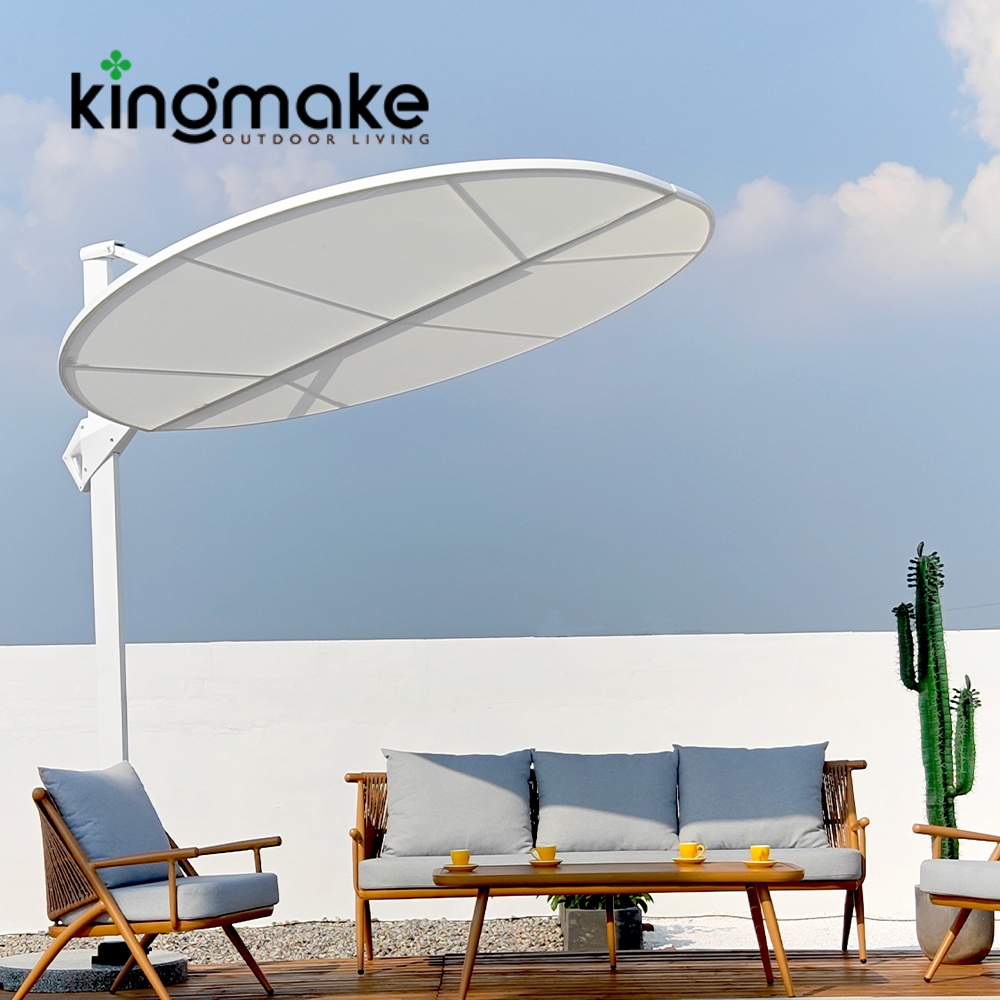
How to Measure a Patio Umbrella: Canopy Size Guide
Quick Answer: How Do You Measure a Patio Umbrella?
Fully open the umbrella and lock it in place.
Measure across the canopy at its widest straight-line span — not along the curved fabric edge.
For round or octagonal canopies, measure from one rib tip, through the center, to the opposite rib tip.
If you can't reach across the top, measure one rib from the center hub to its outer tip, then multiply by two.
If you're replacing the canopy, also record the canopy shape and rib count before you do anything else.
What Does "Patio Umbrella Size" Actually Mean?
| Term | What it measures | Why it matters |
| Canopy diameter | Straight-line width across an open round/octagonal canopy | The number in the product name (e.g., "9 ft umbrella") |
| Canopy width/length | Side-to-side or corner-to-corner span on square/rectangular canopies | Determines footprint over a table |
| Rib length | Center hub to the outer tip of one rib | Used to calculate diameter and to match replacement canopies |
| Pole diameter | Width of the center pole | Determines base and table-hole compatibility |
| Pole height | Ground to the underside of the open canopy | Relevant for clearance under pergolas or balconies — not part of "size" |
| Canopy shape | Round, octagonal, square, rectangular, or custom | Affects both the measuring method and replacement compatibility |
What You Need to Measure a Patio Umbrella
A tape measure (soft or retractable)
A step stool for taller umbrellas
A flat, wind-free surface
Something to record measurements — notes app, spec sheet, or photos
Optionally, a second person to hold the tape measure steady
How to Measure a Round or Octagonal Patio Umbrella
Method 1: Measure Tip to Tip
Fully open and lock the umbrella.
From a stable position (use a step stool if needed), place the tape at the tip of one rib.
Stretch the tape straight across the top, through the center, to the tip of the directly opposite rib.
Convert inches to feet by dividing by 12.
Method 2: Measure Rib Length × 2
Tilt the umbrella or lay it gently on its side.
Measure from the center hub (or finial) along one rib to its outer metal tip.
Multiply that number by 2.
How to Measure a Square Patio Umbrella
Fully open and lock the umbrella.
Measure one edge, corner to corner, along the canopy's straight side.
All four sides should match — that measurement is the umbrella's labeled size (e.g., an 8 ft square umbrella).
How to Measure a Rectangular Patio Umbrella
Fully open and lock the umbrella.
Measure the longer side, corner to corner — this is the length.
Measure the shorter side — this is the width.
Record both dimensions together, e.g., 8 ft × 11 ft.
How to Measure a Cantilever or Offset Umbrella
Canopy length/width or diameter, measured the same way as above
Arm reach, the horizontal distance the frame extends from the base to the canopy center
Frame dimensions, including the footprint of the base or in-ground mount
Rib count
Mounting or attachment configuration — freestanding base, in-ground sleeve, or wall/deck mount
Manufacturer and model, since cantilever hubs and rib attachments are frequently proprietary
How to Measure a Patio Umbrella for a Replacement Canopy
Canopy diameter or dimensions — using the tip-to-tip or rib-length × 2 method
Rib length — center hub to rib tip, measured precisely, not rounded
Rib count — most umbrellas use 6 or 8 ribs, though some commercial models use more
Canopy shape — round, octagonal, square, or rectangular
Frame type — center-pole or cantilever
Pole diameter — measured across the pole itself
Vent configuration — single or double vent affects both airflow and how the canopy attaches at the top
Valance or skirt configuration, if the original canopy has one
Finial or top-opening configuration — the size and shape of the opening at the top vent
Brand and model number, if visible on the frame or original packaging
Photos of the frame, hub, and rib-attachment points
Buying a new umbrella: an approximate canopy size (rounded to the nearest common size) is usually enough for initial planning around a table or seating area.
Identifying an umbrella you already own: record the actual measurement rather than rounding, so you have accurate data if you need it later.
Ordering a replacement canopy: use exact measurements plus rib count, shape, frame type, and brand/model. This is where rounding can cause a canopy that "should" fit to arrive loose, tight, or misaligned at the vents.
Patio Umbrella Measurement Cheat Sheet
| What to measure | How to measure it | Needed for |
| Canopy diameter (round/octagonal) | Tip to tip through center, or rib length × 2 | New purchase, identification, replacement |
| Canopy length & width (square/rectangular) | Corner to corner on each side | New purchase, identification, replacement |
| Rib length | Center hub to outer rib tip | Replacement canopy sizing |
| Rib count | Count ribs around the frame | Replacement canopy compatibility |
| Canopy shape | Visual/physical check | All scenarios |
| Pole diameter | Across the pole, at its widest point | Base selection, table-hole fit |
| Pole height | Ground to underside of open canopy | Clearance planning (not "size") |
| Vent/finial configuration | Visual check of top opening | Replacement canopy compatibility |
| Brand/model | Frame label or original documentation | Replacement canopy compatibility |
Patio Umbrella Size Chart
| Umbrella size (typical) | Common use |
| 6–7 ft | Small bistro table (24"–30") |
| 8 ft | Round table up to 4 ft (2–4 chairs) |
| 9–10 ft | Round or square table, 4–5 ft (4–6 chairs) |
| 10–11 ft, or 8 × 11 ft rectangular | Rectangular table, 6–8 ft (6–8 chairs) |
| 11–13 ft, or multiple umbrellas | Large lounge or conversation area |
What Size Patio Umbrella Do I Need for My Table?
24"–30" bistro tables: a 6–7 ft umbrella is usually enough for one or two people.
36"–48" round tables: 8–9 ft umbrellas typically cover the table and immediate seating.
48"–60" dining tables: 9–10 ft round or an 8 × 11 ft rectangular canopy generally works better than a smaller round umbrella.
6–8 ft rectangular tables: a matching rectangular canopy (e.g., 8 × 11 ft) tends to give more even coverage than a round umbrella of similar square footage — a good fit for outdoor dining furniture sized to the same footprint.
Lounge seating: size around the full seating cluster, not a single chair — grouped outdoor sofas or outdoor loungers usually need a larger cantilever umbrella or multiple umbrellas rather than one canopy per seat.
Poolside seating: factor in that loungers are often repositioned throughout the day, so a slightly larger canopy or a cantilever with wide rotation gives more flexibility — see how many pool deck umbrellas a resort needs for spacing guidance.
Restaurant outdoor dining: consistency across the patio usually matters more than maximizing any single table's coverage — our guide to using commercial patio umbrellas in restaurants covers layout and branding considerations beyond sizing.
Canopy Size vs. Shade Coverage
Sun angle, which changes throughout the day and by season
Umbrella height, since a higher canopy casts a smaller shadow directly beneath it
Canopy shape, as round canopies shade differently than rectangular ones over a rectangular table
Tilt angle, on umbrellas with a tilt feature
Table position relative to the pole
Time of day and geographic location (latitude affects sun angle year-round)
Surrounding buildings, which can add or block shade independent of the umbrella
Wind conditions, which affect how umbrellas are angled or whether they're kept open at all
Measuring Patio Umbrellas for Hotels, Resorts, and Restaurants
Consistency across multiple umbrellas — matching canopy size, color, and frame finish across an entire property
Table and seating layouts — sizing umbrellas to the actual layout, not a generic table size
Base requirements — weight and base type scaled to canopy size, pole diameter, and typical wind exposure
Wind exposure — coastal or elevated sites may need reinforced frames or heavier bases regardless of canopy size; see wind-resistant patio umbrellas for coastal hotels for what to look for
Pedestrian clearance — pole height and canopy overhang around walkways and pool decks
Poolside placement — spacing and canopy size relative to lounger layout, not just table count
Replacement parts — planning ahead for canopy or rib replacement over the umbrella's service life
Fabric durability — UV and salt exposure requirements for the climate
Frame materials — corrosion resistance appropriate to the site
Color consistency — matching umbrella finishes to the property's existing hotel outdoor furniture or resort outdoor furniture collections keeps the overall look cohesive across a full property or across multiple properties in a portfolio
Quantity planning — accounting for damaged units, seasonal storage, and future expansion
Custom dimensions — properties with non-standard table sizes or architectural constraints
Long-term maintenance — how canopy and frame specs affect maintenance cycles over multiple seasons; proper cleaning and care for outdoor umbrellas also extends canopy life between replacements
Common Patio Umbrella Measurement Mistakes
Measuring a partially opened umbrella. A half-open canopy pulls fabric inward, giving a smaller-than-actual reading. Always fully open and lock the frame first.
Measuring the curved fabric edge instead of the straight span. The arc of the fabric is longer than the straight-line diameter — measure straight across, not along the curve.
Measuring pole height instead of canopy size. Pole height affects clearance, not the umbrella's labeled size.
Ignoring rib length. Rib length is often more reliable than a top-down measurement, especially for replacement sizing.
Ignoring rib count. A replacement canopy built for 6 ribs will not sit correctly on an 8-rib frame, even if the diameter matches.
Measuring only the old fabric when ordering a replacement. Worn or stretched fabric can measure differently than the frame it was built for — measure the frame's rib length, not just the fabric.
Assuming all "9 ft" umbrellas use the same frame. Manufacturing tolerances and design differ by brand; confirm rib length and count rather than relying on the labeled size alone.
Forgetting pole diameter. A base or table hole sized for the wrong pole diameter won't fit properly, regardless of canopy size — and an undersized base for a given canopy is a common cause of tipping in wind. Our umbrella base weight guide has recommended weights by canopy size if you're unsure.
Confusing canopy dimensions with usable shade area. As covered above, canopy size and actual shade coverage are related but not identical.
Using approximate measurements for large commercial orders. A small rounding error on one umbrella is minor; multiplied across a 50-unit hotel order, it can mean a full batch of mismatched canopies.
What Information Should You Send to a Patio Umbrella Manufacturer?
Canopy size (and shape)
Rib count and rib length
Pole diameter and pole height
Umbrella type (center-pole, cantilever, offset)
Photos of the existing frame, if applicable
Brand/model, if known
Required quantity
Intended application (restaurant, hotel, pool deck, residential)
Installation location and typical wind exposure
Preferred fabric type
Preferred frame material
Required color or finish
Frequently Asked Questions
How do I know what size patio umbrella I have?
How do you measure a patio umbrella?
Is patio umbrella size based on diameter?
Do you measure a patio umbrella open or closed?
Is a 9-foot umbrella actually 9 feet wide?
How do I measure a patio umbrella for a replacement canopy?
How do I know what replacement canopy fits my umbrella?
Does rib count matter when replacing a canopy?
Can I put a larger canopy on my existing frame?
Will any 9-foot replacement canopy fit a 9-foot umbrella?
What size patio umbrella is best for a restaurant table?
What umbrella size is best for a hotel pool?
How do I measure umbrellas for a commercial outdoor project?
What specifications should I provide to an umbrella manufacturer?
Need Help Choosing Patio Umbrellas for a Commercial Project?
Email: sales@cnkingmake.com
WhatsApp: +8613925925021

 Whatsapp
 sales@cnkingmake.com
 +8613925925021