Introduction
A store-bought sectional in this size usually sells for around $800. I built one that looks just as good, seats just as many people, and cost me $250 and one weekend of work. If you are new to woodworking or you have built a few things before, this guide will walk you through the whole process. Before you grab your tools, it is worth knowing upfront that this is not a thirty-minute project. A diy outdoor sectional takes basic woodworking skills, a free weekend, and a bit of patience, but the payoff is a custom piece built exactly the way you want it.
Is building your own outdoor sectional actually worth it?
Before diving into plans and cut lists, let's be honest about what this project actually involves. Too many tutorials make a diy outdoor sectional sound like a quick afternoon job that costs almost nothing. In reality, the diy outdoor sectional cost usually lands between $200 and $305 for materials alone, not counting cushions. Plan on spending 12 to 18 hours from start to finish, spread across a weekend or two. You will also need to know how to use a circular saw and a drill with reasonable confidence.
None of that means you shouldn't build one. It just means you should go in with clear eyes. Here is a quick look at how building compares to buying.
| DIY build | Ready-made sectional |
| Cost (no cushions) | $200–$305 | $600–$900 |
| Time to use | 1–2 weekends | Same day delivery in some cases |
| Sizing | Fully custom | Fixed standard sizes |
| Skill needed | Basic woodworking | None |
When DIY makes sense
Building your own patio sectional is a great fit if any of these sound like you:
You already own basic woodworking tools and have built something before, even something small.
You need a specific size that ready-made sectionals simply don't offer, like a tight corner or an oddly shaped deck.
You enjoy the process of building something with your hands, not just the money you save.
When buying ready-made is the smarter choice
On the other hand, buying might be the better call if:
You need outdoor seating right away. A DIY build needs at least a week of planning, shopping, and building before it's ready.
You don't have a garage, driveway, or workshop space to cut and assemble the pieces.
Once you factor in custom cushions, the total cost ends up close to what a finished sectional would cost anyway.
If that last point sounds like your situation, it may be worth looking at a ready-made option instead. Kingmake's
outdoor sectional collection covers a wide range of sizes and styles, including a compact
small outdoor sectional lineup for tighter patios and balconies, all built with weather-resistant materials and backed by a multi-year warranty.
Tools and materials you'll need
Once you have decided that building makes sense for you, the next step is gathering everything before you start cutting. Having every piece of wood and every tool ready before you begin saves you from multiple trips to the hardware store halfway through the project.
Choosing the right wood: pressure-treated vs cedar vs redwood
The wood you choose affects both the price and how much upkeep your sectional will need down the road.
| Wood type | Price per board | Maintenance | Best for |
| Pressure-treated pine | $5–$7 | Needs sealant every 1–2 years | Best budget option |
| Cedar | $12–$18 | Naturally resists rot and insects | Low maintenance, classic look |
| Redwood | $15–$25 | Naturally durable, weathers beautifully | West Coast builders, premium look |
For a first build, pressure-treated pine gives you the best balance of price and strength. For more on how different outdoor materials hold up over time, see our
outdoor furniture materials guide.
The complete tool checklist
You don't need to own every tool on this list. Some are worth buying, and others you can rent from a hardware store for a day.
Circular saw or table saw (buy)
Power drill with driver bits (buy)
Speed square (buy, inexpensive)
Tape measure (buy)
Orbital sander (rent if you don't already have one)
Bar clamps, at least four (rent or borrow)
Level (buy)
Safety glasses and ear protection (buy)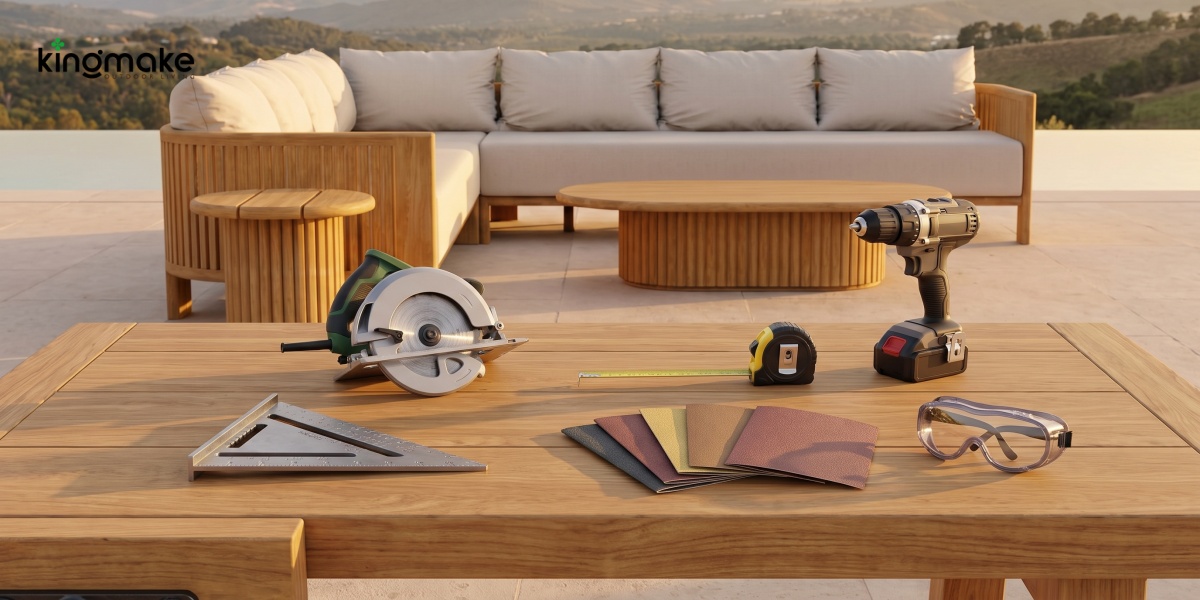
The full materials list and cut list
This is the part most tutorials skip, but it's the part that actually gets your project built correctly. Below is a sample cut list for one seating module using standard 2x4 outdoor sectional plans. Build two of these to create a corner sectional, or more for a longer run.
| Part | Material | Cut size | Quantity |
| Base frame sides | 2x4 | 24 inches | 2 |
| Base frame front/back | 2x4 | 30 inches | 2 |
| Legs | 4x4 | 7 inches | 4 |
| Backrest frame uprights | 2x4 | 26 inches | 2 |
| Backrest frame top/bottom | 2x4 | 30 inches | 2 |
| Seat slats | 5/4 decking board | 30 inches | 6 |
| Backrest slats | 5/4 decking board | 30 inches | 5 |
This same list can be adjusted for longer or shorter modules, which is the whole appeal of working from your own diy outdoor sectional plans instead of a fixed factory size.
Step-by-step to build a 2-piece DIY outdoor sectional
With your materials cut to size, you're ready to start assembly. Follow these eight steps in order, and don't rush the drying times. They matter more than people expect.
Step 1: Build the base frame
Lay your four base frame pieces into a rectangle and screw them together at each corner using L-brackets for extra strength. Check every corner with a speed square as you go, and confirm the whole frame sits level once it's together. A common mistake here is forgetting to leave any gap underneath for water to drain away, which leads to rot much sooner than expected.
Step 2: Attach the legs
Attach one leg inside each corner of the frame, standing 6 to 8 inches tall depending on your preferred seat height. Use both screws and wood glue for a stronger hold, since the legs carry the full weight of the seat. Avoid letting the raw end of each leg sit flush against bare ground or concrete, since that's usually the first part of the build to start rotting.
Step 3: Build the backrest frame
Build a second rectangle for the backrest using the same method as the base. Angle it back slightly, somewhere between 95 and 100 degrees, since a completely straight backrest is surprisingly uncomfortable to sit against. Add a diagonal brace across the back corner to stop it from wobbling forward and back over time.
Step 4: Add the seat slats
Lay your seat slats across the base frame, leaving about a quarter inch gap between each board so rainwater can drain through instead of pooling. Each slat should be screwed down at two points minimum to keep it from warping as it dries out and gets wet again over the seasons.
Step 5: Add the backrest slats
Attach the backrest slats the same way, though you can space them slightly closer together since they take less direct rain than the seat does. Make sure each slat is screwed in evenly so the backrest looks consistent from end to end.
Step 6: Sand all surfaces
Work through your sandpaper grits, starting around 80 and finishing around 220, paying close attention to corners and the area around each screw hole. This step gets skipped more than any other, but it's the difference between a sectional that feels finished and one that gives people splinters the first time they sit down.
Step 7: Apply wood sealant or stain
Apply at least two coats of an outdoor wood sealant, letting each coat dry fully for about 24 hours before adding the next. Even pressure-treated wood needs this step, since that treatment only protects against rot and insects, not against water and sun fading the wood over time. Don't rush this part. Sitting on a sealant that hasn't fully cured will stick to cushions and clothing.
Step 8: Connect multiple pieces into your sectional
Once each module is built and sealed, join them together using metal brackets or wood connectors to form an L-shape or a straight run, whatever fits your space best. Keep these connections easy to take apart so you can rearrange the pieces later or move them individually if needed. For more layout ideas, our guide on
outdoor sectional shapes breaks down which configurations work best for different patio sizes.
Making your own DIY outdoor sectional cushions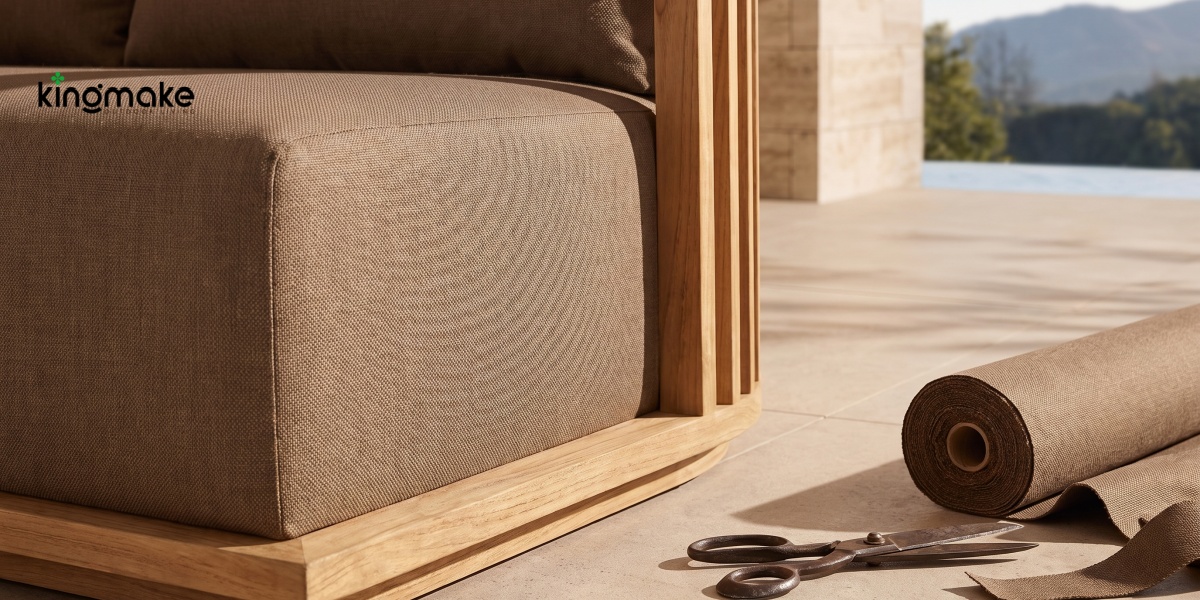
Once the frame is built, most people get stuck right here. Cushions are the part that turns a wooden frame into something people actually want to sit on, and you have two paths to choose from. The first is making your own diy outdoor sectional cushions from scratch, buying high-density foam and outdoor-rated fabric and sewing the covers yourself. This is the cheapest route, but it does require some sewing skill and a bit of patience. The second option is ordering cushions cut to your exact measurements from a supplier, which skips the sewing step entirely but costs more. If you want a deeper look at fabric types, fill options, and how to measure for a perfect fit, check out our full
outdoor sectional cushions guide.
Common mistakes to avoid
A few small errors show up again and again in DIY outdoor furniture builds, and most of them are easy to avoid once you know what to watch for.
Skipping drainage gaps between slats, which causes standing water and faster rot.
Using indoor screws that rust within a season instead of stainless or coated outdoor screws.
Sitting or placing cushions on sealant before it has fully cured.
Building with wood that still has a high moisture content, which leads to cracking and warping later.
Not measuring your space and planning module sizes before cutting any wood, which often leaves cushions that don't fit properly.
Maintaining your DIY outdoor sectional
A handmade wooden sectional needs a bit more attention than a factory-built one, simply because it hasn't gone through the same industrial weatherproofing process. A simple seasonal routine keeps it looking good for years. In spring, check the sealant for any worn spots and reapply where needed. Through summer, try to keep it out of constant direct sun if possible, since that's what causes most cracking. In fall, go over every joint and tighten any screws that have loosened. Once winter arrives, a
weatherproof furniture cover will protect both the frame and your cushions from the harshest weather, and pairing it with a proper
cushion care routine will keep everything looking new for much longer.
Frequently asked questions about DIY outdoor sectionals
How much does it cost to build a DIY outdoor sectional?
A straight, two-piece sectional typically runs $200 to $305 in materials without cushions. Add homemade cushions and the total rises to around $260 to $425. Buying finished cushions instead pushes it to roughly $350 to $550, still well under the $600 to $900 you'd pay for a similar ready-made piece.
What is the best wood for a DIY outdoor sectional?
Pressure-treated pine is the most budget-friendly choice and works well for most builders. Cedar is a great pick if you want less ongoing maintenance, since it naturally resists rot and insects. Redwood looks the most polished but tends to be harder to find outside the West Coast.
How long does it take to build an outdoor sectional?
Most first-time builders need 12 to 18 hours total, including drying time for sealant, which usually spreads across two or three days rather than one long session. Builders with some prior woodworking experience can often finish in 8 to 10 hours.
Do I need woodworking experience to build my own outdoor sectional?
You don't need professional training, but you should be comfortable using a drill and a circular saw. If you've never built anything before, it's worth practicing on a single chair first before tackling a full sectional.
Can I use pallets to build an outdoor sectional?
Yes, and a diy outdoor sectional with pallets can be one of the cheapest options around, since pallets are sometimes free. Just check for an "HT" stamp rather than "MB," which means the wood was heat-treated instead of chemically treated. Pallets also tend to be less structurally sound than fresh lumber, so plan on extra bracing and more sanding to smooth out the rough surfaces.
How do I make my DIY outdoor sectional weatherproof?
Weatherproofing comes down to three layers of protection. Start with wood that resists rot on its own or has been pressure-treated. Add at least two coats of sealant and plan to reapply it once a year. Finally, choose cushions made from genuinely waterproof fabric and store them, or cover the whole piece, when it's not in use. A
furniture cover makes this last step much easier.
Conclusion
Building your own outdoor sectional is a realistic weekend project for anyone with basic tools and a bit of patience, and the savings compared to buying ready-made are hard to ignore. Whether you follow the 2x4 outdoor sectional plans above exactly or adjust the sizing to fit your own patio, the process stays the same: solid framing, proper drainage, a few coats of sealant, and cushions that suit your space.
If after reading all this you'd rather skip the sawdust and go straight to relaxing,
Kingmake has spent 18 years designing and manufacturing outdoor furniture for hotels, resorts, and homes around the world. Browse the full outdoor sectional range or explore the complete
Kingmake Outdoor Furniture product catalog to find a ready-made piece built to the same standards, without the weekend of work


 Whatsapp
 sales@cnkingmake.com
 +8613925925021