
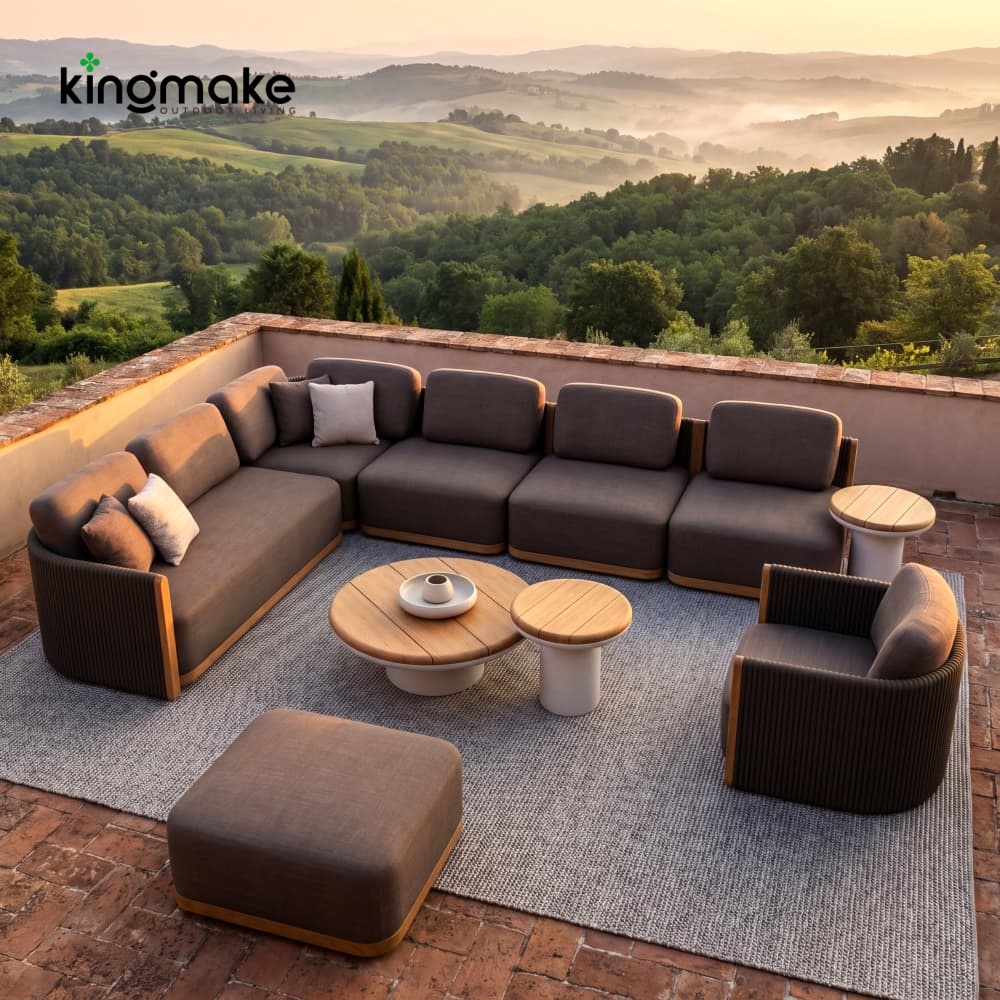
U-Shaped vs L-Shaped vs Curved Outdoor Sectional Guide
Updated October 2026 · About a 10-minute read
Most people searching for an outdoor sectional shape guide are really asking one question: which shape will actually fit the space and the way it gets used? A u shaped outdoor sectional seats the most people. An l shaped outdoor sectional fits the most patios. A curved outdoor sectional looks the best around a fire pit or on a round terrace. The right pick comes down to floor size, how many people sit at once, and whether the layout ever needs to change.
This guide gives you the numbers behind each shape: footprints, seat counts, clearances and the cost differences. It also covers what hotel buyers, designers and furniture resellers should check before they place an order, because a shape that works on a showroom floor can still fail on a pool deck.
Which Outdoor Sectional Shape Is Best? The Short Answer
Are L-shaped sectionals better than U-shaped? For most patios, yes. An L-shape uses a corner, leaves the middle of the space open and costs less per seat. A U-shape is better only when you have the floor area for it and you regularly seat six or more people facing each other.
Choose an L-shape for average patios, rectangular decks, balconies and any space with a walkway or door nearby.
Choose a U-shape for large patios, hotel lounges and entertaining areas where conversation is the point.
Choose a curved shape for fire pits, round or irregular terraces, and spaces where the furniture is meant to be the focal point.
U-Shaped vs L-Shaped vs Curved: Side-by-Side Comparison
The difference between an L-shaped and a U-shaped sectional is simple: an L has two sides that meet at a 90° corner, a U has three sides wrapped around a central table. A curved sectional replaces the corners with a continuous arc. Here is how that plays out in practice.
| Factor | U-Shaped | L-Shaped | Curved |
|---|---|---|---|
| Typical seats | 6–10 | 4–7 | 4–8 |
| Common assembled size | 120–180 in wide × 90–120 in deep | 85–130 in × 60–100 in | 110–160 in across the arc |
| Practical floor area (incl. walkways) | About 12 × 12 ft and up | About 9 × 11 ft and up | About 10 × 10 ft and up |
| Space efficiency | Lowest | Highest | Medium |
| Reconfiguration | Good if modular | Good if modular | Limited |
| Relative cost | Medium–high (more pieces) | Lowest per seat | Highest per seat |
| Best for | Entertaining, large families, hotel lounges | Most patios, corners, balconies | Fire pits, round terraces, statement spaces |
Sizes vary a lot by brand, arm width and cushion depth, so treat these as planning ranges. Always work from the drawing of the exact configuration you are buying.
U-Shaped Outdoor Sectional: The Most Seats, the Most Floor Space
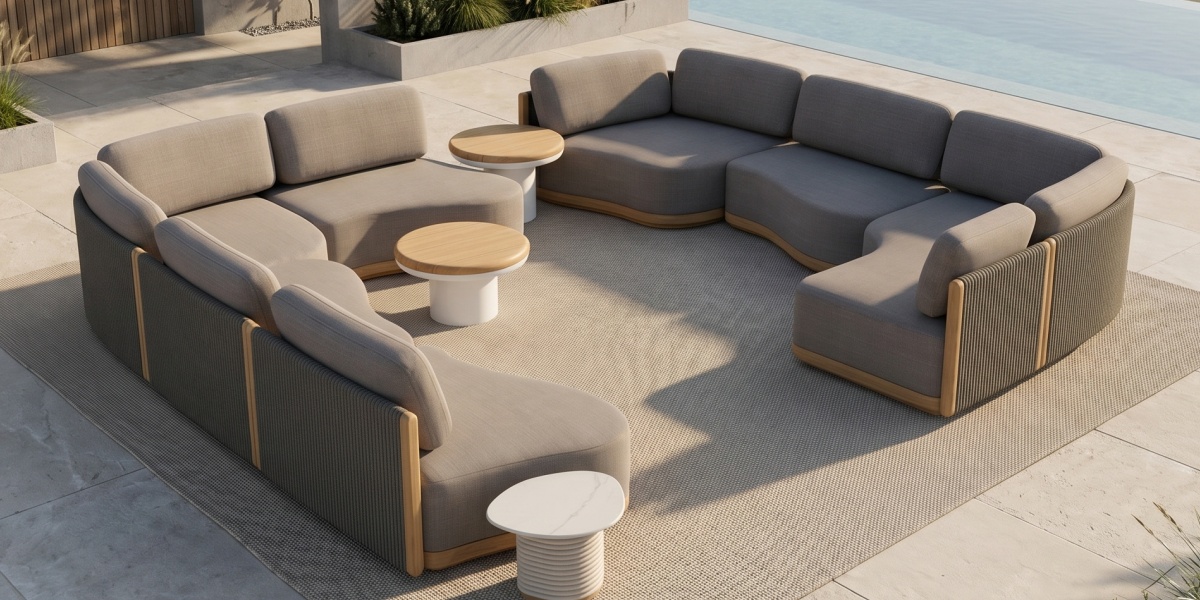
A u shaped outdoor sectional wraps seating around three sides of a coffee table or fire table. Everyone faces in, nobody has their back to the group, and drinks are within reach from every seat. That is why U-shapes are the default for hotel lounge zones, rooftop bars and family patios that host on weekends.
When a U-Shape Is Worth the Space
If you are furnishing a large patio for a big family, or asking which sectional suits entertaining, the U-shape is usually the answer. It works best when:
You regularly seat six or more people at once.
The seating area can be open on one side for access, with no door or main walkway cutting through it.
There is room for a central table with 14–18 in of leg room between the table and each seat edge.
It does not work well on narrow decks, along a main path, or anywhere people need to walk through the seating area to reach a door or pool.
Small U-Shaped Outdoor Sectionals
Compact U-shapes exist, usually around 100–110 in across, but they lose most of what makes a U-shape useful. The inside opening gets too tight for a proper table, and the corner seats become awkward to get in and out of. On a patio under roughly 10 × 10 ft, two facing sofas or an L-shape with a lounge chair usually seats the same number of people with better access. Our guide to the small outdoor sectional has layouts for that size range.
What to Check Before Buying a U Shape Patio Sectional Sofa
Two corner modules. A true U needs two corners. Some collections only make one corner, which limits you to an L.
Inside opening. Ask for the clear distance between the two arms of the U, not just the outside dimensions. That number decides what table fits.
Connectors. A u shaped outdoor furniture set has more joints than any other shape. Clips or brackets keep modules from drifting apart when people sit down and stand up.
Covers. One cover big enough for a full U is heavy and hard to handle. Split covers are easier; see our outdoor sectional cover guide for sizing.
L-Shaped Outdoor Sectional: Fits Most Patios
An l shaped outdoor sectional sits in a corner and leaves the rest of the floor open. That one fact explains why it is the most common shape on residential patios and a safe choice for many commercial terraces. It is also the easiest to grow: add a corner and a few armless modules and an L becomes a U.
Compact L-Shaped Sectional Dimensions for Balconies
For an apartment balcony or a small deck, look for an l shape outdoor sectional set with a long side of 70–90 in and a short side of 55–65 in. A three-piece set in that range seats three people and fits a space of roughly 6 × 8 ft, as long as you keep at least 24 in clear in front of the balcony door. Shallower seats help here. A usable seat depth of 20–22 in keeps the overall depth under about 30 in, which leaves room to walk past. Our outdoor sofa seat depth and height guide explains how to read these numbers on a spec sheet.
L-Shaped Layout Ideas for a Rectangular Patio
Placement changes how much seating you get from the same set. Three layouts that work on rectangular patios:
Long side on the long wall. Put the long run of the L along the longest wall and let the short side close off one end. This leaves the most open floor and the clearest walkway.
Floating L with chairs. Pull the L off the walls, anchor it with an outdoor rug, and place two lounge chairs opposite. You get U-shaped seating without paying for a U, and the chairs can move.
L plus dining zone. Tuck the L into the far corner and put a dining table at the other end of the rectangle. Long patios handle two zones better than one oversized sofa.
Left-Arm or Right-Arm? Get It Right on the Drawing
Brands describe left and right differently. Some go by the view facing the sofa, others by the person sitting in it. Before you order, mark the short side of the L on a top-view plan and have the supplier confirm it. On a multi-room hotel order with mirrored layouts, this one detail causes more reorders than anything else.
What Drives an L-Shaped Outdoor Sofa Quote
If you are collecting quotes for L-shaped outdoor sofas, compare them on the same basis. Price moves mainly with:
Frame material. Powder-coated aluminum, teak and rope-wrapped aluminum price very differently. Steel is cheaper up front but rusts in wet or coastal sites. Our outdoor sectional materials comparison covers lifespans.
Cushion build. Standard foam vs quick-dry foam, and polyester vs solution-dyed Olefin or Sunbrella fabric.
Module count. Two long pieces cost less to make than five small modules, but the modular version is easier to ship and rearrange.
Custom sizes or finishes. Standard sizes are cheapest. Non-standard lengths may need new drawings and a sample.
As a rough guide for homeowners, weather-resistant outdoor sectionals that seat five or more mostly sell at retail in the $1,000–$3,000 range for aluminum frames with outdoor fabric, with teak sets going higher. Trade and project pricing depends on quantity and specification.
Curved Outdoor Sectional: Best Around a Fire Pit
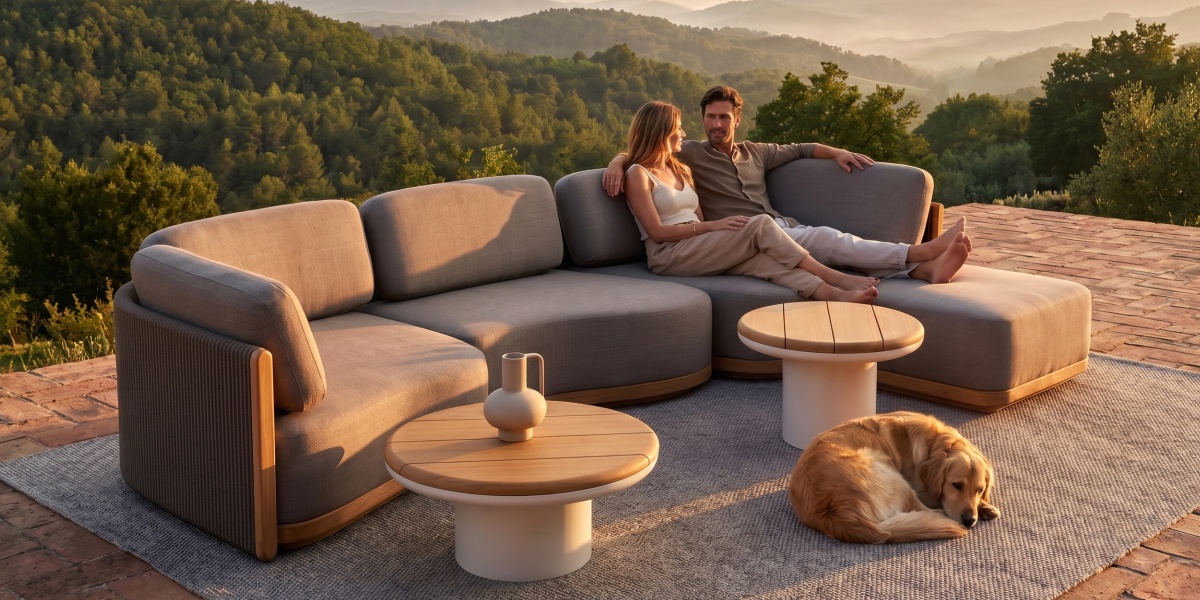
A curved outdoor sectional (also sold as a rounded or crescent sectional) swaps hard corners for one continuous arc. Every seat angles slightly inward, so people talk to each other without twisting. It also looks good from behind, which matters when the sofa floats in the middle of a terrace instead of backing onto a wall.
Where a Curved Patio Sectional Couch Makes Sense
Around a round fire pit or fire table. Each seat sits at about the same distance from the fire, which a straight sofa can't do.
On round or irregular terraces. A curve follows the edge of the space instead of leaving dead corners.
In hotel lobbies, pool decks and villa gardens where the furniture is part of the design, not just seating.
Quarter Arc, Half Curve or Semi Circle Outdoor Sectional
| Arc | Coverage | Works best with |
|---|---|---|
| Quarter arc | About 90° | A softer replacement for an L in a corner |
| Half curve | About 120–150° | Fire pit seating with chairs closing the circle |
| Semi circle | About 180° | Large round terraces, resort pool decks, statement lounges |
The Trade-Offs
Curved sectionals are the least flexible shape. Most can't be rearranged into anything else, and against a straight wall the back of the arc leaves wedge-shaped gaps you'll need to fill with planters or side tables. They also cost more. Bending aluminum tube to a consistent radius takes tooling and tighter quality control, curved cushions need their own patterns, and curved modules pack less efficiently in a container. Expect a curved set to cost noticeably more than an L-shape with the same seat count, often in the region of 20–40% more, and more again for a custom radius.
Modular or Fixed: Does the Shape Need to Change?
An outdoor sectional made of separate pieces is more practical than a fixed sofa when the space or the use changes. A modular L can become a straight sofa for a party, two loveseats for a narrow deck, or a U when you add a second corner. A fixed set is cheaper and feels more solid, but what you buy is what you keep.
Go modular if you might move, renovate or rearrange for events, or if you run a hotel or restaurant where layouts change by season.
Go fixed if the patio size is settled and you want the lowest cost per seat.
The catch with modular: pieces from different collections, or even different production years, may not line up. Record the collection name and module codes when you buy. Our modular outdoor sectional guide explains the piece types and how to plan expansion.
How to Size Any Outdoor Sectional Shape
Measure the space before you look at products. The steps are the same for every shape:
Measure the usable floor, excluding steps, planters, grills and door swings.
Take off 36 in for every main walkway and 24 in for secondary paths along a wall or railing.
Allow about 28–32 in of sofa width per person. Corner seats count as one seat, not two.
Leave 14–18 in between the seat edge and the coffee table.
Compare what is left against the assembled outside dimensions, not the seat dimensions.
If two shapes fit, pick the one that leaves more clearance. Tight layouts always feel smaller in person than on a plan.
Choosing Sectional Shapes for Hotels, Resorts and Commercial Projects
For a commercial project, the shape also has to work for staff, cleaning crews and repeat orders. For spacing, materials and procurement on hotel and resort projects, see our commercial outdoor sectional furniture planning guide. Two points are specific to the shape decision: custom sizing and how you brief a supplier.
Custom Sizes and Fabrics: What It Costs
Changing fabric color within a supplier's standard range usually adds little. Changing dimensions is different. A new length or depth on an L or U often means revised drawings and a sample, which adds time and may raise the minimum quantity. A custom radius on a curved sectional costs the most, because the frame bends and cushion patterns have to be made for that curve. Ask for the sample cost, MOQ and lead time for the exact change before you commit.
What to Send a Supplier for an Accurate Quote
A floor plan with the furniture zone dimensioned, and doors, steps and paths marked.
The shape and seat count per group, plus how many groups in total.
Left/right orientation marked on a top view.
Frame, fabric and cushion preferences, and whether quick-dry foam is needed.
Delivery destination and target arrival date.
Ask for an itemized list of every module, table and cover, so you can compare quotes line by line. The commercial outdoor sectional page lists the specification points worth confirming.
Working With Kingmake Outdoor
Kingmake Outdoor has built outdoor seating in Foshan, Guangdong since 2008, from an 18,000㎡ factory that handles design, welding, powder coating and inspection in-house. As an outdoor furniture manufacturer working mainly with hotels, resorts, distributors and project contractors, we see the same shape questions on most sectional enquiries, and the answers above come from those projects.
For L-shaped and straight layouts, the Albert modular lounge sofa combines an aluminum frame, woven rope and teak arm details, with left-arm, right-arm and armless modules that can be arranged as an L, a straight row or separate seats. For curved designs, our tube-bending line is checked to a 0.5° tolerance, which is what keeps a multi-module arc lining up seat to seat; you can see the process on our manufacturing page. Sizes, finishes and fabrics can be adjusted through our OEM service, and the factory holds ISO 9001 certification, with sofa lines tested by TÜV SÜD.
If you are sourcing patio furniture for a project or a retail range, send us your layout and we will suggest the shape, modules and quantities that fit.
Frequently Asked Questions
Are L-shaped sectionals better than U-shaped?
For most patios, an L-shape is the better choice because it fits a corner, leaves floor space open and costs less per seat. A U-shape is better when you have at least about 12 × 12 ft of usable space and regularly seat six or more people.
What is the difference between an L-shaped and a U-shaped sectional?
An L-shaped sectional has two sides joined at one corner. A U-shaped sectional has three sides and two corners, wrapped around a central table. The U seats more people but needs much more floor area and an open side for access.
Can a U-shaped outdoor sectional fit on a small patio?
Compact U-shapes around 100–110 in across exist, but on patios under about 10 × 10 ft they leave too little room for a table and walkways. An L-shape plus a lounge chair usually seats the same number of people more comfortably.
Are curved outdoor sectionals more expensive?
Yes. Bent frames, curved cushion patterns and less efficient packing usually put a curved outdoor sectional well above an L-shape with the same number of seats. A custom radius adds further cost because of tooling and sampling.
Can I turn an L-shaped sectional into a U-shape later?
Only if it is modular and the collection offers a second corner and extra armless pieces. Fixed L-shaped sets can't be extended. Buy additional pieces from the same collection and confirm the connectors match.
How much does a weather-resistant outdoor sectional for five or more people cost?
At retail, most aluminum-frame sectionals with outdoor fabric that seat five or more fall roughly between $1,000 and $3,000, with teak and designer sets higher. Commercial pricing depends on quantity, materials and how much customization is involved.
Is a modular sectional better than a fixed patio sofa set for a large covered patio?
For a large patio used for entertaining, modular is usually better, because you can split it into conversation groups or reshape it for events. A fixed set makes sense when the layout will never change and budget is the priority.
The Bottom Line
Start with the floor plan, not the photos. If the space is average or rectangular, an L-shaped outdoor sectional will almost always fit best. If it is large and built for hosting, a U-shaped outdoor sectional gives the most seats. If there is a fire pit or a round terrace, a curved outdoor sectional is worth the extra cost. Whatever the shape, confirm the assembled dimensions, the left/right orientation and whether pieces can be added later before you order.

 Whatsapp
 sales@cnkingmake.com
 +8613925925021