Introduction
You pull the cover off your outdoor sectional on the first warm day of spring, feeling good about the protection you put in place last fall. Then you see it: dark mold spots creeping across two cushions and a faint musty smell rising from the fabric underneath. The cover looked fine all winter. Inside, though, moisture had been quietly working against you.
This scenario is more common than most patio owners realize. A poor-quality or poorly chosen outdoor sectional cover does not just fail to protect your furniture - it can actively trap moisture and accelerate the damage it was supposed to prevent. The good news is that choosing the right cover is straightforward once you understand three things: which material actually performs in your climate, how to measure your specific sectional shape, and how to use the cover correctly through the seasons.
This guide covers all three. Whether you are shopping for a waterproof outdoor sectional cover for a coastal property or a large outdoor sectional cover for a hotel terrace, you will find practical guidance here - no filler, no guesswork.
Do You Actually Need an Outdoor Sectional Cover?
It is a fair question. High-end outdoor sofas are built to withstand the elements, and some premium fabrics like Sunbrella carry manufacturer warranties that imply weatherproof durability. So why bother covering them?
The data tells a clear story: uncovered outdoor furniture has an average usable lifespan roughly 40% shorter than covered equivalents, according to studies from outdoor furnishings trade groups. Even the best weather-resistant fabrics are designed to tolerate exposure, not thrive under prolonged standing water, UV bombardment, and debris accumulation. Sunbrella, for instance, is resistant to mildew growth - but it is not immune when water pools and sits in the folds of an uncovered cushion for days.
The argument for covering is strong in almost every climate. The decision logic simply shifts by region:
Hot and sunny climates (Southwest, Mediterranean): UV degradation is the primary enemy. A cover extends color vibrancy and fabric integrity significantly.
Humid or coastal climates (Southeast US, tropical regions): Moisture and salt air drive mildew. A breathable, waterproof cover is close to essential.
Cold climates with snow: Freeze-thaw cycles damage frame joints and cushion foam. Covering (and ideally storing cushions indoors) is the single highest-ROI protective habit.
Mild or dry climates: Even here, bird droppings, tree sap, and sudden rain events justify at minimum a lightweight cover during extended periods of non-use.
The short answer: yes, you need one. The longer answer is that buying the wrong one can cost you more than buying none at all.
Outdoor Sectional Cover Materials: What the Ratings Actually Mean
The most overlooked number on any waterproof outdoor sectional cover listing is the PU waterproof rating, expressed in millimeters. It tells you the height of a water column the fabric can resist before moisture penetrates. Here is what the numbers mean in plain terms:
PU 1000mm: Handles light drizzle. Fine for areas with mild, infrequent rain.
PU 2000mm: Handles moderate to heavy rain comfortably. The minimum recommended for most regions.
PU 3000mm+: Handles heavy downpours and sustained rain without issue. Worth the small extra cost in high-rainfall climates.
Here is a quick comparison of the three main outdoor sectional cover material categories:
Material | PU Rating | Weight | Breathability | UV Resistance | Lifespan | Price Range |
600D Oxford Polyester | PU 2000mm+ | 600D | Good (vented) | Moderate | 3-5 years | $40-$80 |
Solution-Dyed Acrylic | N/A (breathable) | Heavy | Excellent | 5+ years | 5-8 years | $120-$200 |
PEVA / PVC | Fully waterproof | Light | None | Low | 1-2 years | $20-$40 |
600D Oxford Polyester: The Sweet Spot for Most Buyers
For the vast majority of homeowners and hospitality projects, 600D Oxford polyester with a PU 2000mm+ coating is the ideal balance. The 600D weight rating means the fabric is dense enough to resist tearing and abrasion, yet light enough to handle and store without effort. Well-designed versions include side air vents with insect mesh to prevent the condensation buildup that plagues sealed covers. Expect a lifespan of three to five years under normal use and a price point of roughly $40 to $80 for most sectional sizes.
If you are buying a patio sectional cover for the first time and want a reliable, value-for-money choice, this is the material to prioritize.
Solution-Dyed Acrylic: The Premium Long-Term Choice
Solution-dyed acrylic - the same material category used in Sunbrella and similar performance fabrics - is the right choice when you want a cover that goes the distance without annual replacement. The colorfastness is exceptional because the pigment is baked into the fiber itself rather than applied as a surface coating, meaning UV exposure does not cause bleaching or brittleness over time. These covers offer excellent breathability, strong mildew resistance, and a five-to-eight-year service life. The trade-off is price: expect to spend $120 to $200 depending on the size.
This is the go-to option for commercial projects, resort properties, and homeowners who want a genuine one-time purchase. Brands like
Kingmake Outdoor Furniture integrate similar high-performance fabrics across their hospitality and residential outdoor furniture collections.
PEVA and PVC: Fully Waterproof but With Hidden Drawbacks
PEVA and PVC covers are completely waterproof because they allow zero moisture transmission - which is also their main flaw. In summer, they trap heat and humidity inside the cover, creating a greenhouse effect that accelerates mold and mildew growth on cushions and frames. In winter, they become brittle in freezing temperatures and crack along fold lines. The lifespan is typically one to two years, and the material adds nothing useful in warmer months.
Use PEVA or PVC only as a short-term or emergency solution. For any cover you plan to use season after season, stick with 600D polyester or solution-dyed acrylic.
Key Features to Look For in an Outdoor Sectional Cover
Material is the foundation, but the difference between a cover that performs well and one that frustrates you daily comes down to the smaller details. Here are the five features that matter most.
Tie-Down Straps and Buckle Systems
An outdoor sectional cover with straps is not optional in most settings - it is a practical requirement. Wind can travel under an unsecured cover and flip it off in minutes, defeating the entire purpose. Look for straps that are at least one inch wide, with a minimum of four anchor points around the base. Adjustability of plus or minus six inches from the default length lets the cover fit across slight size variations. In regions that regularly experience wind speeds above 25 mph, buckle straps are essential; bungee-style cords simply are not reliable enough.
Air Vents and Condensation Control
This is the feature that separates a cover that protects your furniture from one that quietly destroys it. Without ventilation, the temperature differential between daytime and nighttime causes moisture to condense on the interior surface of the cover and drip onto your cushions - mimicking rainfall from the inside. A quality cover has at least two mesh-lined air vents on the sides. The mesh keeps insects out while allowing airflow to equalize temperature and humidity. If a cover does not list ventilation as a feature, treat it as a red flag.
UV-Resistant Coating and Colorfastness
A cover that degrades from sun exposure within a season or two is not a good investment. Look for a minimum UPF 30+ rating on the cover itself. On color choice: lighter shades (stone, beige, tan) tend to hold their appearance better over time because they absorb less heat and experience less thermal stress on the UV coating. Darker covers (charcoal, black) absorb more heat - useful for quickly drying a damp cover, but harder on the material long-term.
Handle Placement for Easy Use
A large outdoor sectional cover can be awkward to manage alone, especially on an
L-shaped outdoor sectional cover that wraps around a corner. Well-designed covers position handles at both the front and rear, allowing one person to align and settle the cover accurately without a second set of hands. For L-shaped configurations, look for covers with at least one handle near the corner seam for precise positioning.
Storage Bag: A Surprisingly Useful Quality Indicator
The storage bag included with a cover is a small detail that signals a lot about the manufacturer's standards. A breathable cotton or canvas bag allows the folded cover to continue releasing any residual moisture during storage, preventing mold on the cover itself. A sealed plastic bag traps that moisture. If you see a plastic bag in the product images, assume the rest of the cover quality follows the same cost-cutting logic.
How to Measure Your Outdoor Sectional for the Right Cover Size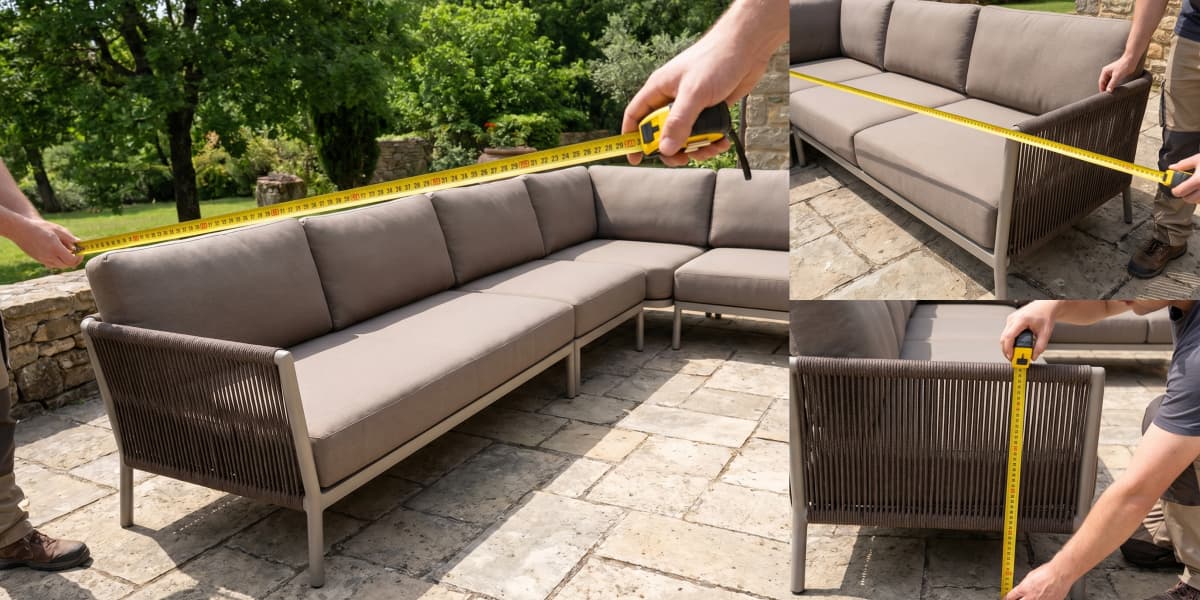
Choosing the wrong size is the most common purchasing mistake, and it is entirely avoidable. The key principle: always measure the full outer footprint of your sectional, not the interior dimensions, and add four to six inches to each measurement so the cover drapes down to approximately two inches above ground level.
How to Measure an L-Shaped Outdoor Sectional
Step-by-step measuring guide for L-shaped sectionals:
Measure the longest outer edge from one outside corner to the other outside end. This is your width.
Measure the shorter outer edge of the L from the corner to the outside end. This is your depth.
Measure the tallest point from the floor to the top of the backrest.
Add 4-6 inches to both the width and depth measurements for proper drape coverage.
Important: The interior corner dimensions of your L-shape do not affect the cover size. You only need the maximum outer dimensions. A well-made L-shaped outdoor sectional cover will have extra fabric in the corner that folds neatly without needing to match the interior angle exactly.
How to Measure a U-Shaped Outdoor Sectional
U-shaped sectionals require two key measurements: the total width from one outer end to the other, and the total depth from the front edge of the center section to the back edge of the rear panels. These configurations are almost always better served by split covers - two separate pieces rather than one oversized single cover - because a single cover large enough to wrap a full U-shape is extremely heavy and difficult to position correctly. Split covers are also much easier to store.
Standard Cover Sizes: Quick Reference Chart
Use this as a starting point. Always verify against your own measurements before purchasing.
Size Label | Shape | Width Range | Depth Range | Best For |
Small (S) | Linear / 2-piece | 58"-72" | 30"-36" | Compact patios |
Medium (M) | L-shaped / 3-piece | 90"-108" | 36"-48" | Standard L-shapes |
Large (L) | L-shaped / 4-piece | 108"-120" | 48"-60" | Large L / small U |
Extra Large (XL) | U-shaped / 5+ piece | 120"+ | 60"+ | U-shapes / large sets |
Best Outdoor Sectional Covers: Our Top Picks for 2026
The following picks cover the five most common buyer scenarios. Each recommendation is based on real material performance, not sponsorship or retail affiliation. Pricing reflects typical online retail in mid-2026.
Best Overall Outdoor Sectional Cover - Editor's Choice
Material: 600D Oxford polyester | PU Rating: 2000mm | Includes: 4 buckle straps, mesh air vents, canvas storage bag | Price: $55-$70
This profile covers about 90% of buyers well. The combination of PU 2000mm waterproofing, genuine breathability through side vents, and a secure four-point strap system handles most weather scenarios and fits most sectional configurations. It is the best outdoor sectional cover choice for homeowners who want a single reliable product without overcomplicating the decision. Look for this spec whether you are buying from a dedicated outdoor furniture brand or a general home goods retailer.
Best Premium Cover: Solution-Dyed Acrylic
Material: Solution-dyed acrylic | UV Warranty: 5 years | Includes: 6 adjustment straps, reinforced corner hems | Price: $140-$180
If you are outfitting a resort property, high-end villa, or a home where you simply do not want to revisit this purchase for the better part of a decade, solution-dyed acrylic is the answer. The UV resistance is genuinely five-plus-year durable, the breathability is the best of any cover material, and the mildew resistance is outstanding even in coastal or humid climates. This is the outdoor sectional furniture cover for buyers who value longevity over initial price.
Best Budget Outdoor Sectional Cover (Under $45)
Material: 600D Oxford polyester | PU Rating: 1500mm+ | Includes: 2-4 straps | Price: $30-$45
A budget pick does not have to mean a bad one. The non-negotiable floor for any cover worth buying is 600D polyester with at least PU 1500mm and some form of strap securing system. There are covers at this price point that clear that bar. What you give up is typically strap count (two instead of four) and storage bag quality. For mild climates or seasonal use, this is a perfectly reasonable starting point. The one thing to avoid at the budget tier: PEVA or thin 150D covers that look similar in listing photos but perform far worse.
Best Cover for L-Shaped Outdoor Sectionals
Shape: L-shaped specific | Material: 600D Oxford | PU Rating: 2000mm | Includes: Corner-positioned straps, 2 placement handles | Price: $60-$85
A cover specifically designed for an L-shaped outdoor sectional cover configuration differs from a standard rectangular cover in meaningful ways. The corner seam is reinforced to resist stress where the fabric changes direction, and the strap placement accounts for the asymmetric shape. Standard rectangular covers technically fit L-shapes, but they generate excess fabric in the corner that catches wind and looks untidy. If your sectional is L-shaped, a purpose-designed cover is worth the modest additional cost.
Best Extra-Large Outdoor Sectional Cover
Coverage: 120"+ wide | Material: 600D Oxford | PU Rating: 2000mm+ | Includes: 6 straps, split-panel option available | Price: $80-$120
A large outdoor sectional cover for a full U-shaped or five-plus-piece configuration is a specialized product. The weight alone can make a single-piece cover difficult to handle, so the best options in this category offer a split-panel design with a center overlap zone - two lighter pieces that together cover the full footprint. This is especially practical for hotel terraces and commercial settings where staff may need to cover and uncover furniture daily. Look for reinforced hem stitching on covers at this scale, as the material stress during deployment and removal is considerably higher than on smaller sizes.
How to Use Your Outdoor Sectional Cover by Season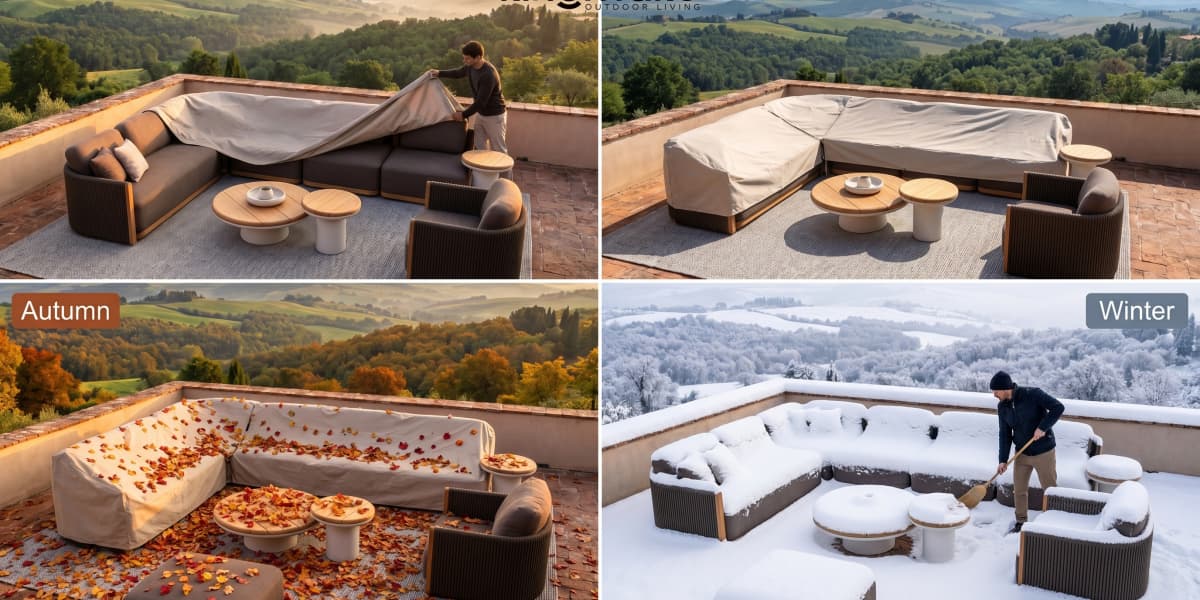
A cover is not a set-and-forget solution. How you use it across the year has a bigger impact on your furniture's condition than the cover material alone. Here is the seasonal protocol that genuinely works.
Spring (inspection and restart): Remove the cover and inspect it before putting it back into service. Check for mildew, tears, and buckle condition. Wipe down the sectional frame and allow cushions to air out fully before re-covering. This is also the time to confirm your outdoor sectional cushions are in good condition for the season ahead.
Summer (as-needed use): In dry weather, you do not need to cover your sectional every evening. Reserve the cover for rain events and extended periods when the furniture will not be used. Daily covering in hot, humid weather increases condensation risk - counterproductive if your cover lacks adequate ventilation.
Autumn (full coverage season): As leaf fall begins and temperatures drop, move to consistent covering. Organic debris like leaves and sap can stain and damage fabric rapidly if left in contact. Autumn is also when humidity typically rises in most regions.
Winter (snow management): In snowy climates, clear accumulation from the cover within 24 hours. Heavy snow stresses cover seams and frame joints. Below 20F (-7C), store cushions indoors for best protection.
A Common Mistake: Never Cover Wet Furniture
Covering a sectional while it is still damp after rain is one of the most damaging habits in outdoor furniture care - and one of the most widespread. The cover traps the moisture inside a warm, dark, low-airflow environment: ideal conditions for mold. The rule is simple: wait at least two hours after rain stops before covering, or select a cover with large mesh vents that can tolerate the ambient moisture without creating a sealed chamber. When in doubt, wait longer.
How to Clean and Store Your Outdoor Sectional Cover
The cover itself needs maintenance, too. Neglecting it leads to the same mold and degradation issues you are trying to prevent on the furniture.
Frequency: Clean the cover once per quarter during active use seasons.
For 600D polyester covers: Rinse with a hose and mild soap, scrub gently with a soft brush on any soiled areas, rinse thoroughly, and hang to dry completely in the open air before folding.
For solution-dyed acrylic: Use a diluted mild detergent. Avoid bleach and high-pressure washing, which can strip the UV coating. Air-dry fully.
End-of-season storage: The cover must be fully dry before folding into the storage bag - not just surface-dry, but thoroughly dry through the folds. Store in a cool, dry location. Do not compress the folded cover under heavy items, as this can crack any applied waterproof coating.
Frequently Asked Questions About Outdoor Sectional Covers
Should I cover my outdoor sectional every night?
Not necessarily. If you live in a dry climate or your sectional is positioned under a roof overhang or pergola that provides meaningful shelter, nightly covering adds little protective value and increases the handling wear on your cover. The clearer case for nightly covering is in humid, rainy, or coastal climates - or during seasons with heavy dew, leaf fall, or bird activity. In those contexts, a consistent covering habit pays off. The simplest test: if your furniture looks dirty or damp most mornings, cover it nightly. If it does not, cover it when rain is expected and during multi-day absences.
Can I leave an outdoor sectional cover on all summer?
This depends almost entirely on the cover material. A 600D polyester cover with proper mesh air vents can stay on through summer without causing harm, as the ventilation prevents heat and humidity from concentrating underneath. A PEVA or PVC cover absolutely should not stay on all summer: without breathability, daytime heat turns the interior into a humid greenhouse that actively encourages mold and can warp foam cushioning. If your cover does not have vent panels and you plan to leave it on during summer, switch to a vented model before doing so.
What size cover do I need for a 3-piece outdoor sectional?
A three-piece sectional is most commonly a linear sofa-plus-two-seater setup or an L-shaped configuration. For a linear arrangement, a cover in the range of 90 inches wide by 36 to 40 inches deep typically fits. For an L-shaped three-piece, you are usually looking at a medium (M) or large (L) L-shaped specific cover, roughly 100 to 110 inches on the long side and 55 to 65 inches on the short side. Always measure your actual sectional using the steps in the measuring section above, as three-piece sets vary significantly in depth and arm width across manufacturers. Refer to our
full outdoor sectional guide for dimension examples.
How do I stop my outdoor sectional cover from blowing off?
There are three levels of wind protection you can apply, in increasing order of permanence:
Buckle straps (standard): A four-strap system with at least one-inch-wide straps handles normal wind conditions up to roughly 25 mph. Tighten fully after applying the cover.
Corner weights or sandbags: For high-wind events or covers without built-in straps, small sandbags placed on each corner of the cover apron add substantial resistance.
Elastic hem cord: Some covers include a continuous elastic cord sewn into the lower hem. Combined with straps, this gives the tightest possible seal at the base and is the most wind-resistant configuration available for standard sectional covers.
If you are in a consistently high-wind location (coastal, hilltop, or open plain), prioritize outdoor sectional covers with straps as a baseline requirement rather than an optional feature.
Conclusion
The right outdoor sectional cover is not necessarily the most expensive or the most heavily marketed one. It is the one that matches your climate's demands, fits your sectional's actual dimensions, and has the functional details - vents, straps, storage - to stay useful across multiple seasons. For most buyers, a 600D polyester cover with PU 2000mm rating, four straps, and mesh vents will deliver three to five years of strong performance at a reasonable cost. For commercial properties or buyers who want to buy once and be done, solution-dyed acrylic is worth the higher initial investment.
Whatever you choose, the most important habits are consistent: cover only dry furniture, manage seasonal transitions proactively, and clean the cover itself quarterly. Your outdoor sectional is a significant investment in comfort and outdoor living - protecting it properly is straightforward with the right information in hand.
For compact patio solutions, our guide to
small outdoor sectionals covers sizing, material choices, and layout ideas for tighter spaces.

 Whatsapp
 sales@cnkingmake.com
 +8613925925021