
Pergola vs Pavilion: What Is the Difference and Which Is Better?
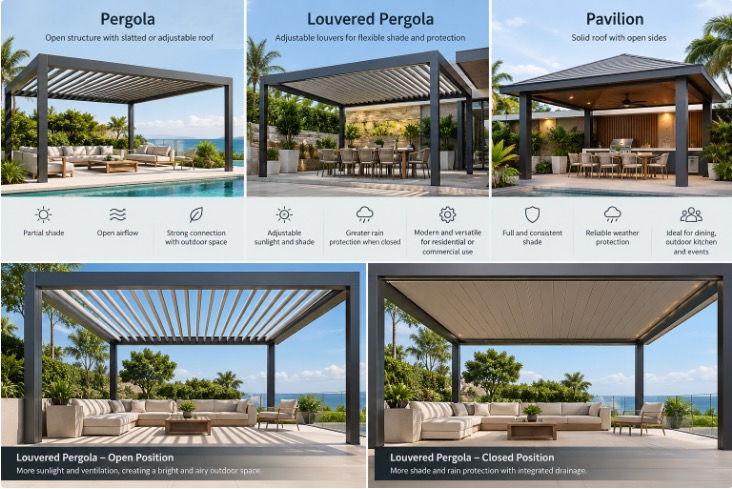
A pergola usually has an open, slatted, or adjustable roof that prioritizes airflow and partial or controllable shade. A pavilion has a solid roof supported by posts, providing consistent overhead protection from sun and rain.
The biggest difference between a pergola and pavilion is therefore the roof. Choose a pergola when you want a lighter outdoor space with greater control over sunlight and ventilation. Choose a pavilion when permanent overhead coverage is the priority.
There is 1 important exception to this traditional distinction. A modern louvered pergola uses adjustable aluminum blades that can open for sunlight and airflow or close to create substantially more overhead protection. With integrated drainage, a closed louvered roof behaves much more like a pavilion than a traditional open pergola.
This makes the pergola vs pavilion decision less about definitions and more about how you want the outdoor space to perform.
Key Takeaways
A pergola usually has an open or adjustable roof, while a pavilion has a permanent solid roof.
A louvered pergola combines both concepts because its roof can open for airflow and close for more shade and rain protection.
Pavilions are usually better when you need constant overhead shelter, especially for outdoor kitchens, events, or large dining areas.
Pergolas are better for flexible outdoor spaces such as terraces, pool areas, lounges, and gardens.
The final choice should consider weather protection, shade, airflow, maintenance, cost, and local permit requirements.
For hotels, resorts, and restaurants, a louvered pergola is often the most flexible option because the same space can adapt to changing weather conditions.
Pergola vs Pavilion at a Glance
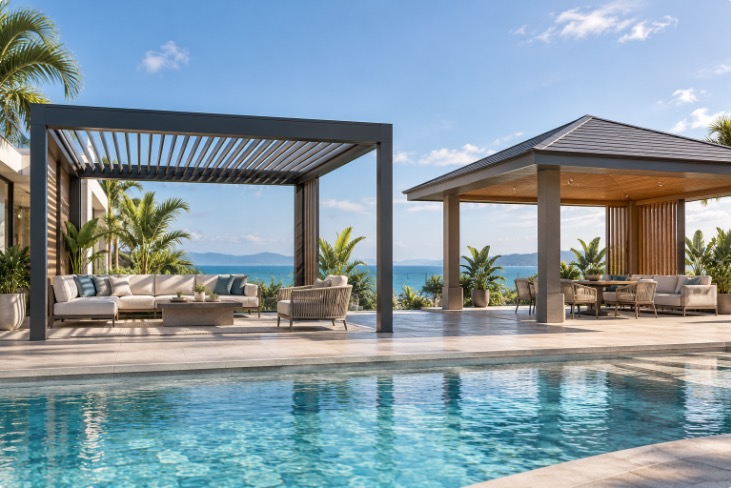
| Factor | Pergola | Pavilion |
|---|---|---|
| Roof | Open slats, fixed slats, retractable canopy, or adjustable louvers | Permanent solid roof |
| Rain protection | Limited with an open roof, much greater with a properly designed closed louvered system | Consistent protection beneath the roof |
| Shade | Partial or adjustable | Full and consistent |
| Airflow | Very open, particularly with the roof open | Open sides, but less ventilation through the roof area |
| Typical use | Terraces, pool areas, lounges, dining spaces, gardens | Outdoor kitchens, covered dining areas, events, large group spaces |
| Cost pattern | Simple systems can be less complex, while motorized louvered systems add cost | Solid roofing and heavier structural requirements can increase cost |
| Maintenance focus | Finish, louvers, motors, drainage, and moving parts where applicable | Roofing, gutters, drainage, frame, and finish |
| Best for | Flexible shade and an open outdoor atmosphere | Permanent overhead shelter |
In simple terms, choose a pergola if you want to see the sky and adjust the outdoor environment. Choose a pavilion if you want dependable overhead cover without needing to change anything.
A louvered pergola sits between these 2 options because the roof can move between open and closed positions.
What Is a Pergola?
A pergola is an outdoor structure made of vertical posts supporting an overhead framework of beams, rafters, slats, or adjustable louvers.
Traditional pergolas have an open roof. They define an outdoor room and provide filtered shade while allowing sunlight and air to move through the structure.
Modern pergolas can provide much more control. Adjustable louvered systems use rotating roof blades that allow users to change the amount of sunlight, shade, and ventilation. When the louvers close, water can be directed toward integrated gutters and drainage channels.
Pergolas generally fall into 2 main groups:
• Traditional pergolas: Fixed beams or slats in materials such as wood or aluminum. These structures create partial shade but do not provide dependable rain protection.
• Adjustable pergolas: Louvered roofs or retractable coverings that allow users to modify overhead protection as conditions change.
Kingmake's motorized louvered pergola, for example, uses aluminum blades that can rotate up to 100° and can be operated by remote control.
Pergolas may be freestanding or attached to a building. A freestanding pergola can be positioned on a terrace, pool deck, garden, or rooftop. An attached pergola extends an indoor space outward and uses the building as part of the overall structure.
For a deeper explanation of specifications and applications, see the Kingmake pergola design, materials and features guide.
What Is a Pavilion?
A pavilion is a freestanding outdoor structure with a solid roof supported by posts and generally open sides.
Its defining feature is permanent overhead coverage. Unlike an open pergola, a pavilion does not allow users to expose the space to the sky. Instead, the roof remains in place at all times.
Pavilions commonly use gable or hip roofs finished with materials such as metal panels or shingles. Because the roof must carry its own weight and manage rain, wind, and potentially snow, pavilions generally require substantial posts, beams, anchoring, and foundations.
They are commonly used for outdoor kitchens, picnic areas, dining spaces, event venues, poolside shelters, and other areas where dependable coverage is more important than adjustable sunlight.
Pergola vs Pavilion: 7 Key Differences
1. Roof Design and Weather Protection
A pavilion provides permanent rain protection beneath its roof, while a traditional pergola does not.
An open pergola allows rain to pass through the roof. Furniture and cushions beneath it therefore need to tolerate outdoor conditions or be stored when necessary.
A pavilion uses a solid roof that continuously sheds rain.
A louvered pergola changes this comparison. When the blades close, they form a much more continuous overhead surface and direct water toward gutters and drainage channels.
The important distinction is control:
• A traditional pergola stays open.
• A pavilion stays closed.
• A louvered pergola can move between both conditions.
No open sided outdoor structure completely prevents wind driven rain from entering around the edges. Side screens, curtains, or sliding glass panels can provide additional protection where required.
2. Shade and Airflow
A pavilion provides consistent shade, while a pergola gives greater control over light and ventilation.
The solid pavilion roof blocks direct overhead sunlight continuously. This is useful where permanent shade is required, although warm air cannot escape through the roof.
A traditional pergola creates filtered shade and allows heat to rise between the slats.
A louvered pergola gives the most control. The blades can be angled to block direct sunlight while maintaining airflow, closed for stronger shade, or opened more fully when additional light is wanted.
For terraces exposed to strong morning or afternoon sun, roof orientation also matters. The direction of the slats influences how sunlight enters as the sun moves.
3. Size, Layout and Use
Pergolas are particularly effective for defining individual outdoor zones. Pavilions are often used to cover larger permanent activity areas.
A pergola can frame:
• A dining table
• A poolside lounge
• A hot tub
• A hotel terrace
• A garden seating area
• A rooftop lounge
Kingmake standard pergola configurations cover sizes from approximately 3 × 3 m to 4 × 6 m, while multiple units can be combined for larger terraces.
A pavilion is often selected when the entire area underneath requires continuous coverage, such as a large outdoor kitchen, several dining tables, or an event space.
The correct choice depends more on what sits underneath the roof than on overall size alone.
4. Materials and Durability
Neither a pergola nor a pavilion is automatically more durable. Material, finish, engineering, installation, exposure, and maintenance determine service life.
Common pergola materials include wood and aluminum.
Wood creates a natural appearance but normally requires more maintenance to preserve its finish. Aluminum requires less surface care and is commonly used for modern louvered systems because it can support integrated mechanisms, drainage, lighting, and accessories.
Kingmake uses 6063 aluminum alloy for its louvered pergola systems with powder coated finishes. For coastal and poolside projects, finish selection is particularly important because the structure is exposed to humidity, water, and potentially salt.
Pavilions may use heavy timber, aluminum, or steel frames combined with solid roofing.
Instead of choosing based on general claims about one structure lasting longer, compare the specific frame material, surface treatment, roofing system, hardware, engineering, and warranty.
5. Maintenance
Pergolas and pavilions require different kinds of maintenance.
A traditional wood pergola may require periodic cleaning, staining, or sealing.
An aluminum louvered pergola usually requires less maintenance on the frame, but the moving roof components and drainage system should also be inspected. Kingmake recommends keeping the frame, louvers, gutters, screws, and moving parts clean and checking them periodically.
Pavilion maintenance focuses more heavily on the permanent roof. Depending on the design, this can include:
• Inspecting roofing materials
• Clearing gutters
• Checking drainage
• Inspecting flashing and joints
• Maintaining exposed wood or metal finishes
The more complex the structure becomes, the more important it is to consider maintenance before purchase rather than after installation.
6. Cost
A simple pergola will often require fewer structural and roofing components than a pavilion, but a premium motorized pergola can become substantially more complex.
That means there is no useful universal answer to whether a pergola or pavilion is cheaper.
The main cost factors are:
• Material and finish
• Structure size
• Roof system
• Structural spans
• Foundation and anchoring
• Drainage
• Motors and controls
• Lighting
• Heating or fans
• Screens or glass panels
• Custom dimensions and colors
• Installation conditions
The best comparison is therefore not a generic pergola price against a generic pavilion price. Compare 2 structures designed for the same footprint, site, and required functionality.
7. Installation and Permits
Both pergolas and pavilions need appropriate anchoring and may require permits.
Structural requirements depend on what the structure is installed on, including soil, concrete, pavers, timber decking, or a rooftop.
A pavilion and a closed louvered pergola both create significant surfaces that interact with wind and weather loads. Foundations, fixing points, structural dimensions, and roof drainage therefore need to match the project location.
Kingmake's standard louvered pergola specification includes a snow load rating of 100 kg per square meter, approximately 20 psf. For commercial projects, local wind and rain conditions can also influence column sizing, spacing, anchoring, and other structural decisions.
Permit requirements vary by location. Common factors include:
• Structure size
• Height
• Distance from property boundaries
• Whether the structure is attached to a building
• Electrical work
• Foundations
• Local wind and snow requirements
Check applicable building rules before ordering the structure.
Pergola or Pavilion: Which Should You Choose?
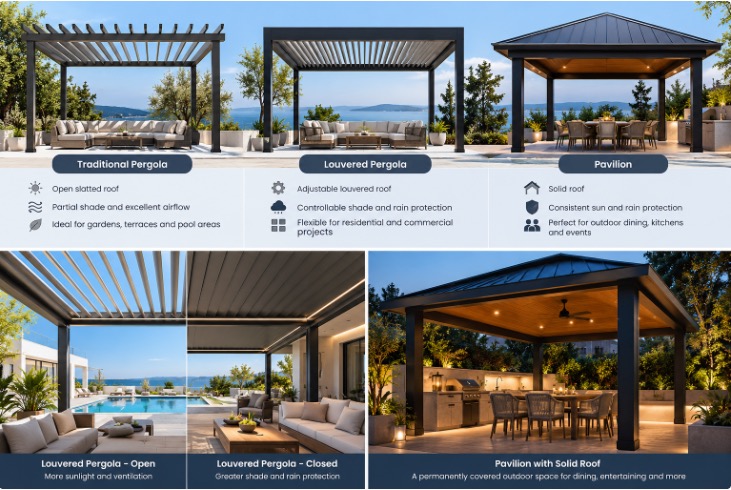
The most useful question is not which structure is better overall. Ask what the outdoor area needs to do.
| Your priority | Better fit | Reason |
|---|---|---|
| Permanent rain cover | Pavilion | The roof is continuously closed |
| Adjustable sunlight and shade | Louvered pergola | The roof position can change throughout the day |
| Simple shade on dry days | Traditional pergola | Open construction provides shade with minimal complexity |
| Poolside lounge | Louvered pergola | Allows adjustment between sun, shade, and airflow |
| Outdoor kitchen | Pavilion or closable louvered pergola | Equipment requires dependable overhead protection |
| Large group gatherings | Pavilion | A continuous roof can shelter a large area |
| Garden feature with climbing plants | Traditional pergola | Open rafters support planting and maintain an open garden character |
| Space used in changing weather | Louvered pergola | The roof can move between open and covered conditions |
A practical way to decide is to look at the months when the area will be used most.
If rain is common and you want permanent shelter without adjusting the structure, choose a pavilion.
If weather conditions change throughout the day and you want to control sunlight and airflow, a louvered pergola provides more flexibility.
If the main goal is simple shade and architectural definition in good weather, a traditional pergola may be sufficient.
Which Is Better for Hotels, Resorts and Commercial Outdoor Spaces?
For many hospitality spaces, a louvered pergola provides more operational flexibility than either a traditional pergola or a fixed pavilion.
The reason is simple: commercial outdoor areas often need to perform differently throughout the day.
Hotel and restaurant dining terraces
A louvered roof can remain open when conditions are comfortable and close when stronger shade or rain protection is required.
Lighting can also be integrated into the structure so the same terrace continues functioning after sunset.
Pool decks
Poolside areas need a balance between direct sun and shaded seating.
A louvered pergola allows guests to use the same space under different conditions. Aluminum is also well suited to environments exposed to water and humidity.
Rooftop bars
Rooftop spaces are valuable but exposed.
A closable roof can reduce the amount of time a rooftop seating area becomes unusable due to changing weather. These projects require careful attention to wind exposure, structural loads, and anchoring.
Outdoor kitchens and bars
Permanent equipment needs reliable overhead protection.
Both a pavilion and a properly designed louvered pergola can work, although cooking equipment, ventilation, drainage, heat, and electrical requirements must be considered during design.
Event spaces
For large groups, weddings, banquets, or other events where permanent shelter is the priority, a pavilion may be the more practical option because its entire roof remains continuously closed.
Kingmake has manufactured outdoor products in Foshan, China since 2008 and operates an 18,000 m² manufacturing facility. Pergola projects can be adapted according to project drawings or site requirements, including dimensions, colors, lighting, screens, and other configuration options.
Explore Kingmake custom outdoor pergolas.
Pergola vs Gazebo vs Pavilion: Quick Difference
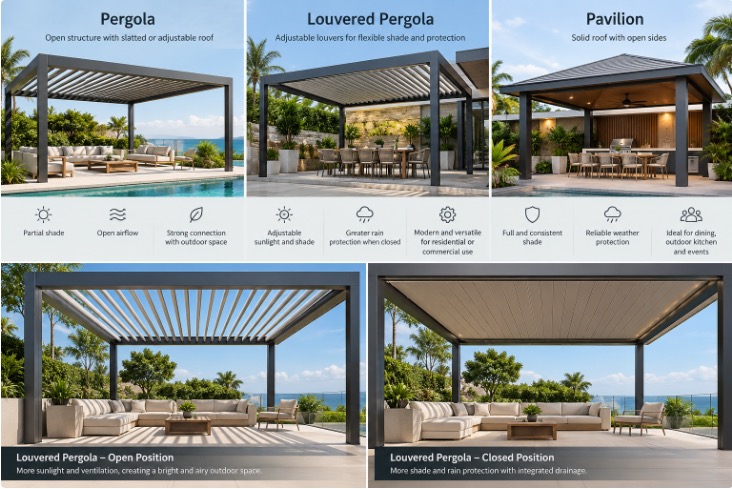
A pergola has the most open roof design of the 3 structures. A pavilion provides the largest type of open sided solid roof shelter. A gazebo is usually a smaller freestanding structure with a solid roof and a more distinct architectural form.
| Structure | Typical roof | Sides | Typical use |
|---|---|---|---|
| Pergola | Open, slatted, retractable, or adjustable | Open | Shade zones, terraces, lounges, outdoor rooms |
| Gazebo | Solid, often peaked | Open or partly enclosed | Garden seating and smaller gathering areas |
| Pavilion | Solid | Open | Dining, events, kitchens, and larger sheltered spaces |
Modern outdoor structures increasingly overlap in appearance and functionality, so roof design and intended use are more useful decision criteria than the product name alone.
Frequently Asked Questions
What is the main difference between a pergola and a pavilion?
The main difference is the roof. A traditional pergola has an open or partially open roof, while a pavilion has a permanent solid roof. A louvered pergola can close its roof, giving it some of the functionality normally associated with a pavilion.
Which provides more shade: a pergola or pavilion?
A pavilion provides consistent full shade because the roof remains closed. A traditional pergola creates partial shade. A louvered pergola allows the amount of shade to be adjusted by changing the angle of the roof blades.
Can a pergola keep rain out?
A traditional open pergola cannot. A properly designed louvered pergola or a pergola with a suitable retractable roof can provide substantial overhead rain protection when closed. Drainage design is essential, and wind driven rain can still enter through open sides.
Is a pavilion more expensive than a pergola?
A pavilion will often cost more than a basic pergola of similar size because of its solid roof and structural requirements. A motorized louvered pergola can narrow or reverse that difference because it adds moving components, drainage, electrical systems, lighting, screens, or other features.
Which is better for an outdoor kitchen?
A pavilion or a closable louvered pergola is usually more suitable because appliances, cabinets, electrical systems, and furniture need reliable overhead protection. Ventilation, heat, drainage, and local safety requirements also need to be included in the design.
Do pergolas and pavilions need permits?
They may. Requirements depend on location, size, height, foundations, attachment to buildings, setbacks, electrical work, and local building rules. Confirm the requirements for the specific project before ordering or installing the structure.
Is a gazebo the same as a pavilion?
No. Both usually have solid roofs, but gazebos are typically smaller and often use a more distinctive round, hexagonal, or octagonal form. Pavilions are generally larger, rectangular, and designed to provide open sided shelter for groups or activities.
Can you combine a pergola and pavilion?
Yes. One project can use a pavilion over an outdoor kitchen and a pergola over an adjacent lounge or dining space. A louvered pergola can also combine some of these functions in a single structure by allowing the roof to open and close.
Choosing the Right Structure for Your Project
Choose a pavilion when permanent overhead coverage is the main requirement.
Choose a traditional pergola when you want a defined outdoor room with filtered shade, good airflow, and relatively simple construction.
Choose a louvered pergola when the same area needs to perform differently as sunlight and weather change.
Before requesting quotes, define 4 things:
• The footprint you want to cover
• What will sit underneath the structure
• The surface or foundation it will be anchored to
• The local structural and permit requirements
This gives suppliers enough information to compare a pergola and pavilion on equal terms rather than comparing 2 completely different specifications.
For hotel, resort, restaurant, villa, or other commercial projects, Kingmake can develop pergola configurations based on drawings, photographs, or site plans and adapt dimensions, finishes, lighting, screens, and other options to the project.
 Whatsapp
 sales@cnkingmake.com
 +8613925925021