Choosing outdoor furniture for windy areas is rarely as simple as picking the heaviest piece available. Wind performance is the combined result of weight, center of gravity, furniture geometry, surface area, material, base design, anchoring, and the specific wind exposure of the site. A dining chair that performs well on a sheltered patio can still tip on an oceanfront terrace or a 20th-floor rooftop.
For
hotel outdoor furniture, resorts, rooftop venues, beachfront properties, and restaurants, getting this wrong carries real consequences: guest safety incidents, damaged furniture, premature replacement costs, and project delays. This guide breaks down what actually makes outdoor furniture wind resistant, compares the materials commercial buyers rely on, and outlines what procurement teams should evaluate before placing an order — including anchoring methods, coastal considerations, and total cost of ownership.
What Makes Outdoor Furniture Suitable for Windy Areas?
Direct answer: Wind-suitable outdoor furniture combines sufficient weight, a low center of gravity, a wide stable base, and — where appropriate — an open or slatted design that lets wind pass through rather than push against a solid surface. No single factor guarantees stability; all four work together.
Weight and Mass
Heavier furniture generally resists wind better because more force is required to move or tip it. This is why cast aluminum, steel, teak, and concrete are common choices for exposed commercial sites. However, weight alone does not make furniture wind resistant. A tall, narrow, heavy piece can still tip if its center of gravity sits too high or its base is too narrow. Weight should be evaluated alongside geometry, not as a standalone metric.
Low Center of Gravity
Furniture with a lower center of gravity resists tipping more effectively than tall, top-heavy designs. Loungers, low-profile sofas, and wide-based dining tables typically outperform tall bar tables and narrow-based stools in the same wind conditions, even at comparable weights.
Wide and Stable Bases
Base width directly affects how much lateral force furniture can withstand before tipping. A dining table with a broad four-leg base or a weighted pedestal base is significantly more stable than one with a narrow single-column base, particularly on rooftops and open terraces where gusts are less predictable.
Open or Slatted Designs
Solid, flat surfaces catch wind like a sail — a phenomenon commonly called the "sail effect." Open-weave, slatted, or perforated designs allow air to pass through the furniture rather than push against it, reducing the net force a gust applies. This is one reason slatted teak and aluminum designs are frequently specified for exposed hospitality projects over solid-panel alternatives.
What Is the Best Material for Outdoor Furniture in Windy Areas?
Direct answer: There is no single "best" material for every windy environment. Teak, cast aluminum, steel, HDPE/poly lumber, wrought iron, and concrete each perform well under different combinations of wind exposure, salt exposure, weight tolerance, mobility needs, and budget. The right choice depends on the specific project conditions.
Reviewing the full range of
outdoor furniture materials available before specifying a product line helps procurement teams weigh these trade-offs against their site's actual conditions rather than defaulting to whatever material a single supplier happens to stock.
| Material | Wind Stability | Weather Resistance | Maintenance | Coastal Suitability | Best Application |
| Teak | High | High | Medium | High | Resorts, hotels, premium projects |
| Cast Aluminum | High | High | Low | High | Hotels, rooftops, restaurants |
| Steel | Very High | High with coating | Medium | Medium–High | High-wind commercial projects |
| HDPE / Poly Lumber | High | High | Low | High | Pool decks, resorts, coastal projects |
| Wrought Iron | Very High | Medium–High | Medium–High | Medium | Highly exposed areas |
| Concrete / Stone | Very High | Very High | Low | High | Permanent public spaces |
The correct material depends on several project-specific variables: how exposed the site is to sustained wind, whether salt spray is a factor, rooftop structural load limits, whether furniture needs to be repositioned for events or cleaning, maintenance staffing, design intent, budget, and whether anchoring is feasible on the surface being used.
Teak vs Aluminum vs Steel vs HDPE for Windy Areas
These four materials cover most commercial outdoor furniture specified for wind-exposed hospitality projects, and each has distinct trade-offs worth understanding before specifying a product line.
Teak is a naturally dense hardwood with high oil content that gives it strong resistance to moisture, salt air, and decay without chemical treatment. Its density contributes meaningfully to wind stability, and its appearance ages into a silver-grey patina that many hospitality brands prefer for premium coastal and resort settings. Maintenance involves periodic oiling or cleaning depending on the desired finish, and teak typically represents a longer-term investment with strong resale and durability value.
Aluminum, particularly cast or extruded aluminum with a powder-coated finish, is lightweight and highly corrosion resistant, making it a strong choice for rooftop applications where structural load is restricted. Its main limitation in wind-exposed settings is that lighter weight can require ballast, weighted bases, or anchoring to reach the stability levels heavier materials achieve naturally. Powder coating protects against salt and UV degradation, and aluminum frames are relatively easy to reposition for events or seasonal layout changes.
Steel offers the highest structural strength of the common commercial materials and, when hot-dip galvanized or powder-coated, holds up well against corrosion. Its weight is a genuine advantage for high-wind commercial projects, though uncoated or poorly finished steel is vulnerable to rust in coastal or humid environments, making finish quality a critical procurement question.
HDPE/poly lumber is a dense, UV-stable synthetic material, often made partly from recycled content, that resists moisture, salt, and fading without the maintenance teak requires. It performs well in pool-deck and coastal resort settings where low upkeep is a priority, and its density gives it reasonable wind stability for loungers and low-profile seating.
For most wind-exposed commercial projects, a practical approach is teak or steel for permanent, higher-wind installations; aluminum with proper anchoring for rooftops and repositionable settings; and HDPE for high-moisture, low-maintenance poolside applications.
Buyers weighing woven materials alongside these options may also find it useful to review how wicker vs rattan vs aluminum durability compares for exposed commercial seating, since woven synthetic wicker is frequently paired with aluminum frames in hospitality lounge and sofa collections.
For hotel and resort procurement teams comparing materials for a specific site, Kingmake's team can review project wind exposure and recommend suitable commercial outdoor furniture material and design options. What Type of Patio Furniture Is Best for High Winds?
Material is only part of the equation — furniture category and design have a direct impact on wind performance.
Outdoor dining tables perform best with sufficient weight, a wide base geometry (four-leg or heavy pedestal), and a manageable tabletop surface area. Glass tabletops add weight but also increase surface area exposed to wind; they should be paired with heavier, wider bases and are generally less suitable for the most exposed sites unless properly weighted.
Outdoor dining chairs benefit from moderate weight combined with a low-profile frame and, where design allows, an open back rather than a solid panel. Stackability is a practical advantage for commercial operators sourcing
restaurant patio furniture who need to store chairs quickly ahead of severe weather.
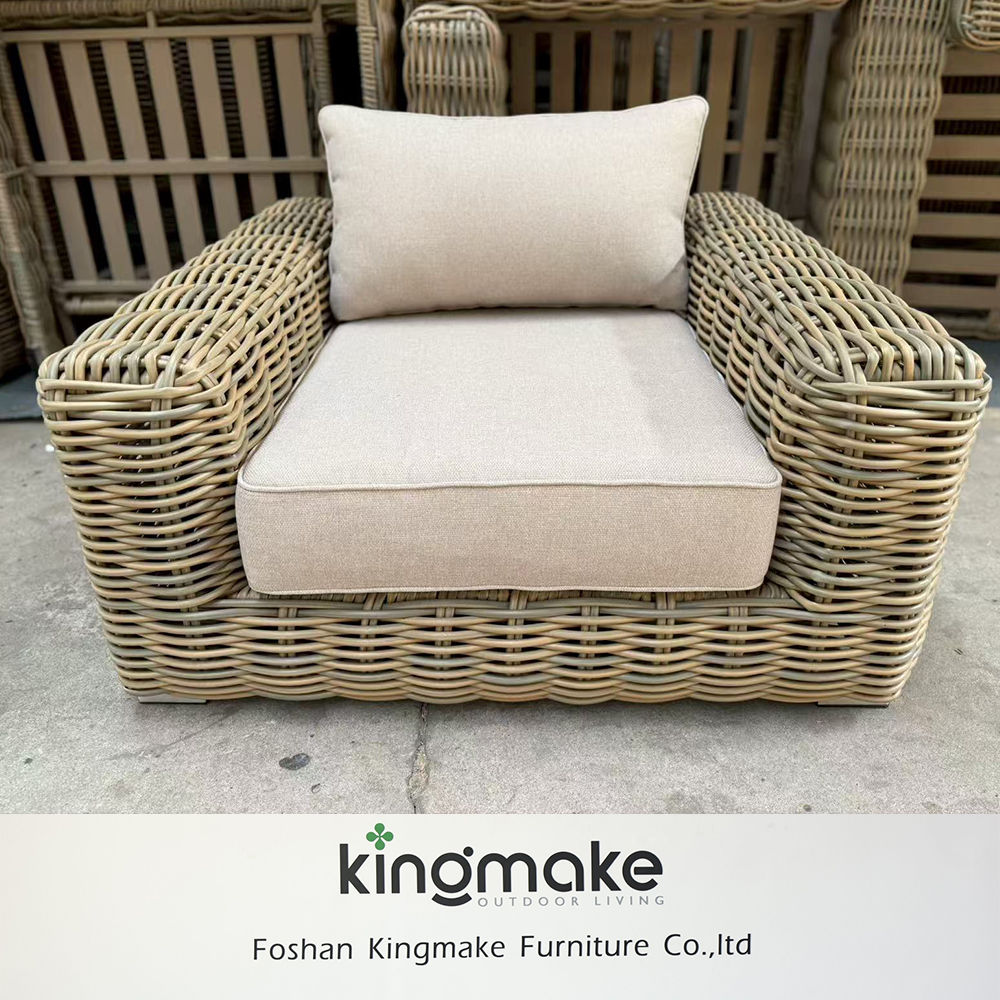
Outdoor sofas and sectionals rely on frame weight and a low center of gravity for stability. Modular sectionals should use secure connectors between sections, and cushions should be fitted with tie-downs or weighted inserts so they don't become airborne even when the frame itself is stable.
Sun loungers and daybeds are naturally lower-profile, which helps, but their long, narrow shape and lightweight frames on some models mean base width and material density still matter significantly, particularly on open pool decks with unobstructed wind paths.
Bar stools are inherently more vulnerable to wind due to their height and narrow base-to-height ratio; they warrant extra caution in exposed rooftop or terrace settings and may need weighted bases even when constructed from heavier materials.
Patio umbrellas require separate wind engineering entirely — umbrella stability depends on base weight, canopy venting, and pole engineering, not on the furniture around them. Umbrellas should never be evaluated using the same weight-based logic applied to tables and seating.
How Do You Keep Outdoor Furniture From Blowing Away?
Direct answer: Keeping
outdoor furniture stable in wind requires a combination of appropriate furniture selection and site-level protective measures — no single step is sufficient on its own for consistently exposed locations.
Choose furniture with adequate weight for the site's wind exposure.
Select low-profile designs where the application allows.
Prioritize wide, stable bases over narrow or single-column bases.
Choose slatted or open-weave designs where wind loading is a concern.
Add weighted bases to lighter furniture such as aluminum tables and umbrellas.
Use mechanical anchors where the surface and structure permit.
Secure modular components, cushions, and loose accessories.
Remove or store furniture during severe storms or forecast high-wind events.
Use properly fitted, breathable furniture covers rather than loose tarps, which can themselves catch wind.
Establish a site-specific storm protocol so operations staff know exactly what to secure and when.
Heavy furniture reduces risk, but it does not eliminate it. Even substantial pieces can shift or tip in sustained high winds or storm-force gusts, which is why anchoring and a clear storm protocol remain necessary at genuinely exposed sites regardless of furniture weight.
How to Anchor Outdoor Furniture in High-Wind Areas
Anchoring converts furniture stability from "resistant" to "fixed," and several methods are used depending on the surface and project requirements:
Through-bolting into decking or structural framing for permanent installations.
Expansion anchors set into concrete slabs or pavers.
Embedded plates installed during construction for a flush, hidden anchor point.
Ground anchors for furniture on soil, sand, or turf.
Weighted bases, used where drilling or penetration isn't permitted.
Stainless steel hardware, which resists corrosion far better than standard steel fasteners in coastal or humid conditions.
Anchoring method selection depends heavily on the surface. Timber decking, concrete slabs, and rooftop membranes each require different hardware and installation approaches. For rooftop projects specifically, furniture anchoring must be coordinated with the building's structural engineer and waterproofing contractor, since penetrating a roof membrane incorrectly can create leaks or void warranties. This guide does not provide specific engineering specifications, since anchoring loads, fastener sizing, and penetration methods should always be confirmed by a qualified structural or installation professional for the actual site conditions.
Best Outdoor Furniture for Coastal and Beachfront Properties
Coastal and beachfront hospitality properties face compounding challenges: constant wind exposure, salt spray, high humidity, intense UV exposure, blowing sand, and the need for frequent cleaning to prevent salt buildup. Furniture selected for these environments needs to perform well against all of these factors simultaneously, not just wind.
Materials commonly specified for coastal projects include teak for its natural weather resistance, powder-coated aluminum for corrosion resistance combined with low weight, stainless steel hardware to prevent rust streaking and fastener failure, HDPE/poly lumber for low-maintenance poolside and beachfront seating, and UV-resistant outdoor fabrics for cushions and upholstery that won't fade or degrade under constant sun exposure. Corrosion resistance and wind stability need to be evaluated together for coastal sites — a material that resists wind well but corrodes quickly in salt air will still require early replacement.
Outdoor Furniture for Rooftops and High-Wind Terraces
Direct answer: Rooftop and high-terrace furniture faces amplified wind conditions due to building height and wind tunnel effects between structures, requiring lower-profile furniture, weighted or anchored bases, and coordination with structural load limits.
Rooftop wind exposure is often significantly stronger and more turbulent than ground-level wind at the same site, due to building height and the way wind accelerates around and between adjacent structures. Rooftop load limits also constrain how much weight can be placed in a given area, which can rule out the heaviest materials in favor of anchored or weighted lighter alternatives. Furniture height should generally be kept lower on exposed rooftops, and maintenance access and emergency storage space should be planned into the layout from the start — not added afterward.
This is especially important for architects, developers, and hotel procurement teams specifying
rooftop outdoor furniture during the design phase, since retrofitting anchoring or reducing furniture load after installation is far more costly than planning for it upfront.
Permanent vs Movable Outdoor Furniture for Windy Areas
| Solution | Stability | Flexibility | Installation | Best For |
| Permanent Anchoring | Very High | Low | More complex | Fixed hotel/resort layouts |
| Weighted Furniture | High | Medium | Easy | Rooftops and terraces |
| Heavy Movable Furniture | Medium–High | High | Easy | Restaurants/events |
| Temporary Tie-Down | Medium | High | Easy | Storm preparation |
Permanent anchoring makes sense for fixed hospitality layouts that rarely change, such as poolside lounger rows or resort dining terraces. Weighted furniture suits rooftops and terraces where drilling isn't feasible but consistent stability is still required. Heavy movable furniture works well for restaurants and event spaces that need occasional reconfiguration. Temporary tie-down systems are appropriate as a storm-preparation measure layered on top of whichever base solution a property already uses.
What Should Commercial Buyers Ask an Outdoor Furniture Supplier?
Procurement teams sourcing furniture for wind-exposed hospitality projects should request clear documentation before committing to an order — not just product photos and pricing.
Commercial Outdoor Furniture Procurement Checklist
Confirm furniture material and construction method.
Confirm product weight and dimensions.
Evaluate wind exposure at the project site.
Check anchoring or ballast options available for the product line.
Confirm corrosion and UV resistance of materials and finishes.
Request technical drawings where custom dimensions are involved.
Review warranty terms in detail.
Confirm MOQ (minimum order quantity) and lead time.
Approve physical samples before mass production begins.
Confirm replacement-part availability for future maintenance.
Beyond this checklist, buyers should also clarify frame specifications, hardware grade (stainless steel vs. standard), finish specifications, packaging methods for freight, shipping timelines, and — for larger hospitality projects — installation support and OEM/ODM development capability if custom dimensions or branding are required. FF&E (Furniture, Fixtures & Equipment) procurement for hospitality projects typically involves coordinating these specifications across architects, interior designers, and operations teams, so having documentation ready in advance shortens approval cycles significantly.
How Much Does Heavy Outdoor Furniture Cost?
Pricing for heavy-duty and wind-resistant outdoor furniture varies widely based on several cost drivers: base material, furniture dimensions, construction complexity, finish quality, hardware grade, level of customization, order quantity, packaging requirements, shipping distance, and any anchoring hardware included with the order.
For commercial buyers, it's worth evaluating furniture through the lens of Total Cost of Ownership (TCO) rather than upfront unit price alone. A lower-cost product that corrodes within two years, requires frequent replacement parts, or needs early full replacement due to wind damage can cost more over a project's 5–10 year lifecycle than a higher-quality piece specified correctly for the site's wind and coastal conditions from the start. Factoring in maintenance labor, replacement frequency, and guest-facing downtime gives a more accurate picture of long-term cost than comparing quotes side by side.
How Kingmake Supports Wind-Exposed Outdoor Furniture Projects
Kingmake has worked with hotel, resort, and hospitality procurement teams for more than 18 years, supporting projects that need furniture matched to real site conditions rather than generic catalog specifications. For wind-exposed and coastal projects, this typically includes material selection guidance based on the project's wind and salt exposure, product recommendations across teak, aluminum, steel, and HDPE lines, custom dimensions and OEM/ODM development for project-specific requirements, technical drawings and material specifications for procurement approval, quality control through production, bulk manufacturing for large-scale hospitality orders, project coordination support, and global delivery logistics.
Kingmake Outdoor does not claim specific wind-speed ratings or engineering certifications unless verified documentation is available for a given product line — buyers evaluating furniture for genuinely high-wind or structurally sensitive sites (particularly rooftops) should always confirm current technical documentation directly and involve a qualified structural professional for anchoring design.
Procurement teams working on a hotel, resort, or rooftop project in a high-wind or coastal location can contact Kingmake's team to discuss material options, custom specifications, and lead times for the specific site conditions involved.
Frequently Asked Questions
What is the best outdoor furniture for windy areas?
There is no single best option — the right choice depends on weight, center of gravity, base design, and site-specific wind exposure. Teak, cast aluminum with anchoring, steel, and HDPE/poly lumber all perform well when matched correctly to the project's conditions and combined with an appropriate base or anchoring method.
What type of patio furniture is least likely to blow away?
Low-profile furniture with a wide base and adequate weight is least likely to blow away. Loungers, wide-based dining tables, and heavier sectional sofas generally outperform tall, narrow pieces like bar stools and single-pedestal tables in the same wind conditions.
Is teak outdoor furniture good for windy areas?
Yes. Teak's natural density contributes to wind stability, and its high oil content gives it strong resistance to moisture and salt air, making it a common choice for coastal hotels and resorts. Regular oiling or cleaning is recommended to maintain its appearance long-term.
Is aluminum outdoor furniture suitable for high winds?
Aluminum performs well in high winds when paired with weighted bases or anchoring, since its lightweight nature is an advantage for rooftop load limits but a disadvantage for stability on its own. Cast aluminum with powder coating is a common rooftop and hospitality choice.
Is steel better than aluminum for windy areas?
Steel generally offers higher wind stability due to its greater weight and structural strength, but it requires proper galvanizing or powder coating to resist corrosion, especially near coastal or humid environments. Aluminum offers easier repositioning and lower long-term corrosion risk without added ballast.
How do you keep outdoor furniture from blowing away?
Use a combination of adequate furniture weight, low-profile design, wide bases, and anchoring or weighted bases where needed. For severe storms, furniture should still be secured, stored, or covered regardless of its weight, since sustained high winds can move even heavy pieces.
How do you anchor outdoor furniture safely?
Anchoring methods include through-bolting, expansion anchors, embedded plates, ground anchors, and weighted bases, chosen based on the installation surface. Rooftop anchoring specifically should be coordinated with a structural engineer to avoid compromising waterproofing membranes.
Can heavy outdoor furniture still blow over in a storm?
Yes. Heavy furniture reduces the likelihood of tipping in normal wind conditions, but sustained storm-force winds can still move or damage even substantial pieces. This is why anchoring, storm protocols, and furniture storage remain necessary at exposed commercial sites regardless of furniture weight.
Conclusion
Selecting outdoor furniture for windy areas comes down to a consistent principle: wind resistance is the product of weight, geometry, center of gravity, base design, material, and anchoring working together — not any single factor in isolation. Commercial buyers evaluating furniture for hotels, resorts, rooftops, or coastal properties get the best long-term results by matching material and design to actual site wind exposure, requesting proper documentation from suppliers, and planning anchoring or weighting into the project from the start rather than as an afterthought. Procurement teams working through this process on an active project are welcome to reach out to
Kingmake's outdoor furniture team for guidance specific to their site conditions.

 Whatsapp
 sales@cnkingmake.com
 +8613925925021