
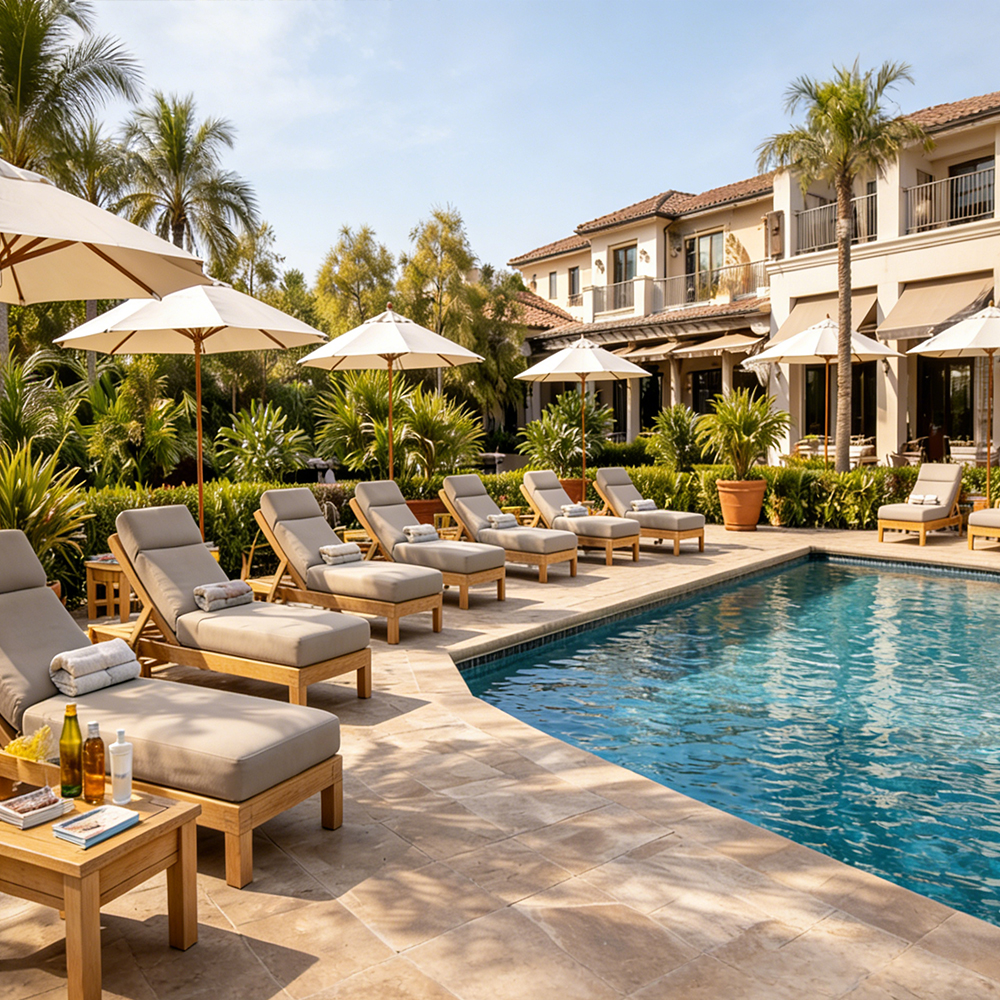
How Many Pool Loungers Should a Resort Pool Have?
This planning worksheet from Kingmake helps hotel procurement teams and resort operators build a quantity brief using guest demand, furniture dimensions, shade and storage. All worked figures below are illustrative assumptions, not industry ratios or a pool-capacity standard.
The Three Quantities to Establish
Quantity | What it means | How to establish it |
Peak lounger demand | Loungers guests want to use or retain during the same peak period | Observations, guest mix and clearly stated planning assumptions |
Deployed lounger count | Loungers placed in service on the deck | A layout reviewed for furniture fit, access and operational requirements |
Total serviceable inventory | Deployed loungers plus approved reserve stock | The deployment plan, maintenance needs and available storage |
These numbers answer different questions. Buying extra furniture does not increase the deck's layout capacity, and having empty loungers in full sun does not necessarily solve a shortage in the shaded zone.
Step 1: Estimate Simultaneous Poolside Demand
For an operating resort, record observations across representative busy days and time windows. Count occupied loungers, temporarily unoccupied loungers still being used by swimmers, unattended items, unavailable units and guests unable to find suitable seating. Note weather, shade and special events.
Occupied chairs alone can understate demand when the deck is already full. Daily admission totals can overstate simultaneous demand because visitors arrive and leave at different times.
For a new property, use an explicit planning model:
Estimated simultaneous pool users = rooms × occupancy × guests per occupied room × simultaneous pool-use share + simultaneous external users.
The pool-use share should refer to one defined pool and time window. External users should cover day-pass or other visitors not already included in the room calculation. If you have several pools, allocate guests between them rather than counting every guest at every pool.
Use a range of scenarios when behavior is uncertain. Review the assumptions after opening instead of presenting a single estimate as a measured fact.
Step 2: Convert Pool Users into Lounger Demand
Peak lounger demand = round up (simultaneous pool users × lounger demand share).
Define the demand share as the proportion of those users who want a dedicated lounger during the same period, including people who retain one while swimming. It is not simply the percentage physically lying on a lounger at the instant of a count.
Account for guests choosing upright seats, restaurant seating or daybeds in this share. Do not reduce the result a second time for the same people. Likewise, count reserved loungers within the overall plan rather than adding them again without identifying a separate demand group.
There is no universal lounger-per-room ratio suitable for every resort. Use the property's service promise and observations to set the target, then document how shortages will be handled.
Worked Example: A Hypothetical 150-Room Resort
Assume the following for one peak period:
Input | Example value | Meaning |
Available rooms | 150 | Rooms included in the forecast |
Occupancy | 80% | 120 occupied rooms |
Guests per occupied room | 2 | 240 in-house guests |
Simultaneous use of this pool | 40% | 96 in-house pool users |
External users at that time | 24 | Additional users, not daily ticket sales |
Lounger demand share | 70% | Assumed share wanting a dedicated lounger |
Estimated simultaneous users: 150 × 0.80 × 2 × 0.40 + 24 = 120 people.
Peak lounger demand: 120 × 0.70 = 84 loungers.
Now suppose the reviewed plan accommodates only 76 loungers after access routes, shade equipment and other furniture are included. The estimated shortfall is 8 loungers. Buying eight extra units and keeping them in storage will not resolve that peak-time layout constraint.
Investigate whether the layout can be revised without compromising required access, whether a different model fits better, or whether another seating zone or admission arrangement is appropriate. Alternative seating only reduces lounger demand if guests are willing to use it.
For sensitivity testing, keeping the 120-user assumption but changing lounger demand share to 60%, 70% and 80% produces 72, 84 and 96 loungers respectively. These percentages are scenarios for this example, not recommended ratios.
Step 3: Check the Deck Using Actual Furniture Dimensions
Start with a scaled plan and the selected lounger in its full operating position. Record its width, reclined length, adjustment space and any projections. Add side tables and umbrella bases to the drawing.
Mark areas that cannot be allocated to furniture: required circulation, pool access equipment, emergency routes, staff positions, doors, queues and other site constraints. Have the project team confirm applicable pool, access and safety requirements before approving the layout. This worksheet estimates furniture demand; it does not determine permitted pool occupancy.
Use Area Calculations Only as an Initial Check
Suppose a hypothetical furniture zone has 210 m² available after main routes and fixed exclusions are removed. If a planning allowance of 5 m² per lounger pair includes the two loungers, a side table and local access, simple division suggests 42 pairs, or 84 loungers.
That is an area-based estimate, not proof that 84 fit. Shape, columns, corners, access and shade bases may reduce the count when drawn to scale. The 5 m² allowance is an illustration, not a spacing rule. Avoid counting the same access space twice or omitting it from both calculations.
Compare the broader poolside furniture options for hotels and resorts, then use the exact dimensions of shortlisted resort sun loungers to test the plan.
Step 4: Check Shade and Seating Zones Separately
Record how many deployed loungers are shaded at relevant times of day. A single photograph or an umbrella count cannot show all-day shade availability. Bases, canopy movement and site exposure also influence the furniture arrangement.
In the example, if 40 of the 84 people wanting loungers prefer shade but only 28 deployed loungers are shaded at that time, the shaded shortfall is 12. This is a subset of the total demand, not 12 additional guests to add to it.
Plan shade alongside seating using the resort pool umbrella planning guide. Review family, quieter lounge and reservable zones separately where those areas serve different guest groups. Premium seating is a choice to evaluate, not a requirement for every resort.
Step 5: Set Reserve Stock and Storage Requirements
Reserve loungers replace units temporarily unavailable for cleaning or repair. They should have a defined storage location and a practical route to the deck.
Target serviceable inventory = deployed count + justified reserve stock.
New units to purchase = target serviceable inventory − retained compatible serviceable units, with a minimum of zero.
If the example property deploys 76 loungers and separately justifies 4 reserves, its target inventory is 80. If it can retain 30 suitable existing loungers, the purchase requirement is 50. This inventory decision still leaves the earlier demand shortfall unresolved; the operator must address it separately.
Choose reserves using observed downtime, repair lead times and storage capacity rather than an automatic percentage. Confirm approved stacking limits, cushion storage, staff handling and weather-related storage arrangements. The lounger material and maintenance comparison can help identify operational questions before ordering.
Copy-and-Fill Resort Lounger Planning Worksheet
Copy this table into your project brief. Replace each blank with a figure, an observation or an assigned action; do not treat an unknown input as zero.
Planning field | Your project entry | Evidence or check |
Pool / zone and peak time window | __ | Identify the area and season |
Rooms × occupancy × guests per occupied room | __ | Forecast or operating records |
Simultaneous pool-use share | ______% | Observation or labeled assumption |
Additional simultaneous users | ______ people | Exclude people already counted |
Estimated simultaneous pool users | ______ people | Formula or direct count |
Lounger demand share | ______% | Include loungers retained during swimming |
Peak lounger demand, rounded up | ______ loungers | Check lower and higher scenarios |
Selected model and operating dimensions | __ | Supplier drawing, width × full length |
Available furniture zone and exclusions | ______ m² / ft² | Scaled site plan |
Reviewed layout capacity / chosen deployment | ______ / ______ loungers | Deployment must not exceed layout capacity |
Unmet peak demand | ______ loungers | Demand minus deployment, minimum zero |
Shaded demand / shaded deployment at stated time | ______ / ______ loungers | Time-specific shade assessment |
Other seating and reservation allocation | __ | Avoid double counting guests |
Reserve stock and reason | ______ loungers | Downtime and replacement lead time |
Storage and handling arrangement | __ | Stack limits, storage area and access |
Retained compatible serviceable inventory | ______ loungers | Count after condition review |
New purchase quantity | ______ loungers | Deployment + reserve − retained inventory |
Outstanding decisions and responsible person | __ | Resolve before order approval |
A Project Reference, Not a Universal Ratio
The published Abmer Beach Club furnishing project in Italy lists 68 sunbeds alongside 48 daybeds and 24 umbrellas. It demonstrates a project using several furniture categories rather than loungers alone.
Those quantities are not a benchmark for another resort: the case does not establish a transferable guest-to-lounger ratio. Use it as a supply reference while calculating your own demand and layout.
Frequently Asked Questions
Should a Resort Buy One Lounger per Room?
Not automatically. Rooms can contain different numbers of guests, and pool use varies by time, property and competing amenities. Estimate simultaneous demand for the specific pool, then validate the layout.
Can I Calculate Quantity from Deck Area Alone?
Area can provide an early estimate, but the final count needs a scaled arrangement using actual furniture dimensions and required clear space. Do not include the water surface or protected routes as furniture area.
How Many Spare Loungers Should We Keep?
Use expected downtime, service history, replacement lead times and storage to justify the number. Reserves support maintenance; they do not increase the permitted or practical number deployed on the deck.
What If the Layout Cannot Meet Peak Demand?
Review the model, zones, shade and operations with the project team. Identify the shortfall explicitly instead of compressing required routes or assuming a different seating type will satisfy every guest.
Turn the Worksheet into a Furniture Enquiry
As a hospitality outdoor furniture manufacturer, Kingmake Outdoor supplies furniture for hotel and resort projects, with customization available for project requirements.
Share your pool layout and quantity brief with your preferred models, finish requirements, delivery destination and target date. Include the deployed count, reserve stock and any retained furniture separately so the quotation reflects what you actually need to purchase.
 Whatsapp
 sales@cnkingmake.com
 +8613925925021