
Contract Grade Outdoor Furniture: How to Choose the Right Commercial Pieces
Introduction
You are reviewing layouts for a hotel terrace, a resort pool deck, or a restaurant patio. The design is set, and now every piece must perform under real conditions. Outdoor furniture will face sun, moisture, cleaning chemicals, and constant guest use.
As you compare options, one term appears often on spec sheets: contract grade outdoor furniture.
So what does contract grade mean in furniture, and does it actually matter for your project? This guide explains what contract grade furniture is, how it differs from residential options, and how to choose pieces that perform reliably in commercial settings.
What Does Contract Grade Mean in Furniture?
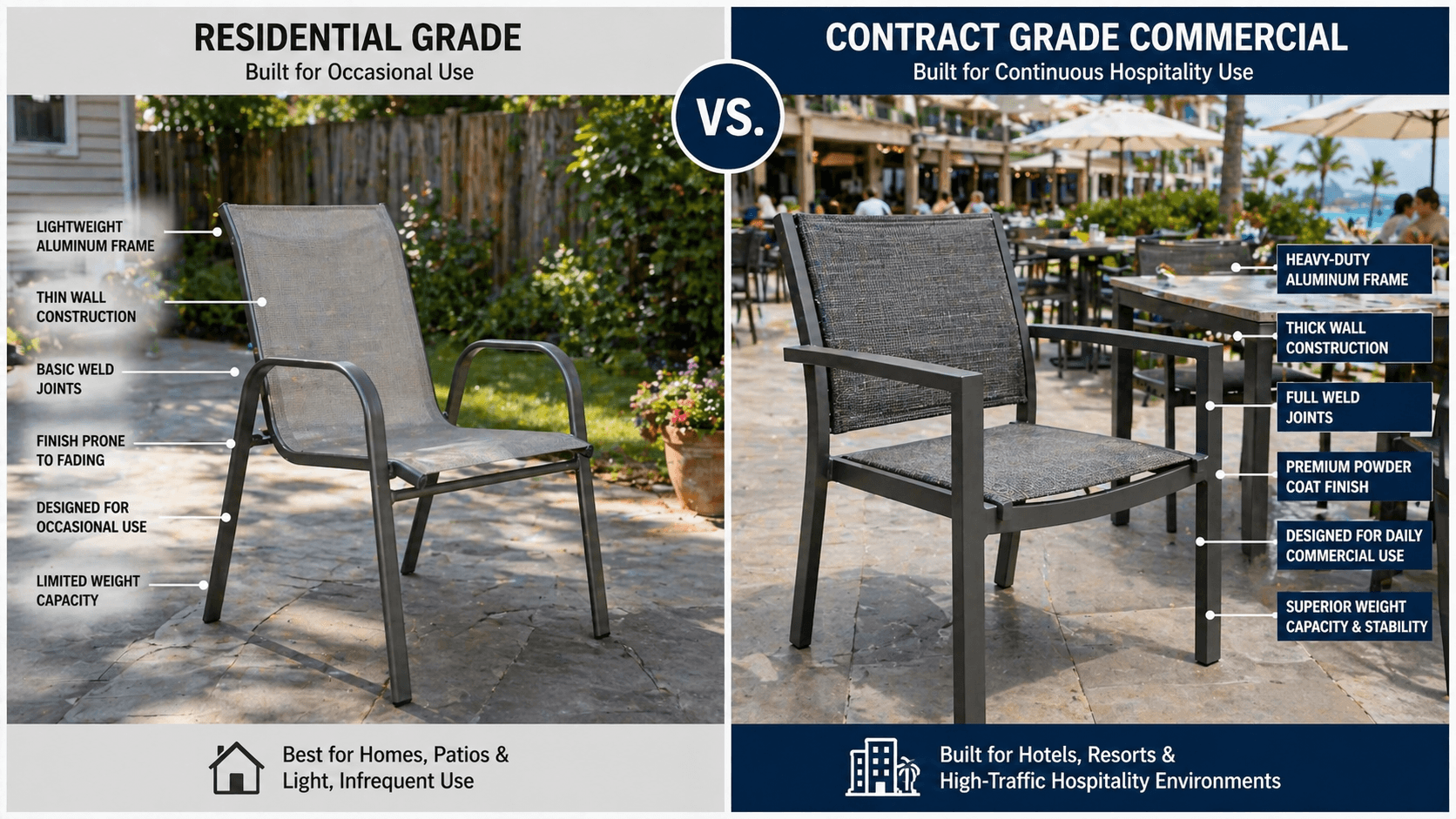
Contract grade furniture is designed and tested for continuous commercial use. It is built for environments where furniture is used many times each day. This includes hotels, resorts, and restaurants. Residential furniture is not built for this level of demand.
In simple terms, contract grade furniture is made to handle weight, movement, and exposure over long periods without failing.
In practice, this means:
Weight capacity typically ranges from 300 to 500 lbs per seat
Frames use reinforced construction with full welds or heavy-duty joinery
Finishes are tested for durability, including resistance to UV exposure and wear
Contract grade outdoor furniture must also perform under sun, moisture, and cleaning chemicals. Materials and coatings are selected to prevent fading, corrosion, and structural damage over time.
It is important to understand that “contract grade” is not a regulated term. Some products use the label without meeting true performance standards.
To verify what contract grade furniture means for a specific product, request:
Detailed spec sheets with weight ratings
Testing certifications such as BIFMA
UV resistance and finish performance data
Warranty details that separate frame, finish, and components
True contract grade furniture is defined by measurable performance. It is not defined by marketing claims.
Contract Grade vs Commercial Grade — Is There a Difference?
“Commercial grade” and “contract grade” are often used interchangeably, but they are not the same.
Commercial grade is a broad term. It suggests suitability for business use, but it does not guarantee specific testing or performance standards.
Contract grade furniture is more precise. It is designed for hospitality use and supported by measurable specifications such as weight ratings, durability testing, and material standards.
For buyers sourcing hospitality contract furniture, this distinction matters. Clear specifications make it easier to compare products and avoid inconsistent quality.
Contract Grade vs. Residential Outdoor Furniture
The difference between contract grade and residential outdoor furniture comes down to usage. Residential furniture is built for light use, often supporting one or two users per day. Contract grade patio furniture is designed for continuous use in hotels, resorts, and restaurants.
It is built to handle constant movement and regular cleaning. Surfaces must resist chemicals, moisture, and sun exposure.
Structurally, the differences are clear:
Frames use heavier-gauge materials such as aluminum or steel
Construction uses full welds instead of spot welds
Hardware uses stainless steel or other high-grade materials
Performance standards also differ:
Weight capacity: 200 to 250 lbs for residential vs 300 to 500 lbs for contract grade
Finish durability: limited resistance vs high resistance to UV, moisture, and cleaning chemicals
Expected lifespan: 1 to 3 years vs 5 to 10 years or more in commercial environments
This is why buyers ask, “is contract grade furniture better?” In hospitality settings, the answer is yes. It is built for continuous use and consistent performance.
Using residential furniture in commercial spaces often leads to early failure. This increases replacement costs, creates guest complaints, and adds liability risk. Contract grade outdoor furniture reduces these issues by meeting higher performance standards.
Quick Comparison: Residential vs Contract Grade
| Feature | Residential Outdoor Furniture | Contract Grade Outdoor Furniture |
|---|---|---|
| Weight Capacity | 200 to 250 lbs typical | 300 to 500 lbs typical |
| Frame Construction | Lightweight, basic joinery | Reinforced frames with full welds |
| Finish Durability | Limited UV resistance | High resistance to UV and weather |
| Expected Lifespan | 1 to 3 years in commercial use | 5 to 10 years or more |
| Warranty Coverage | Limited or undefined | Structured by frame, finish, and fabric |
Materials That Meet Contract Grade Standards
Not all outdoor furniture materials perform the same in commercial environments. Differences come down to composition, structure, and finishing.
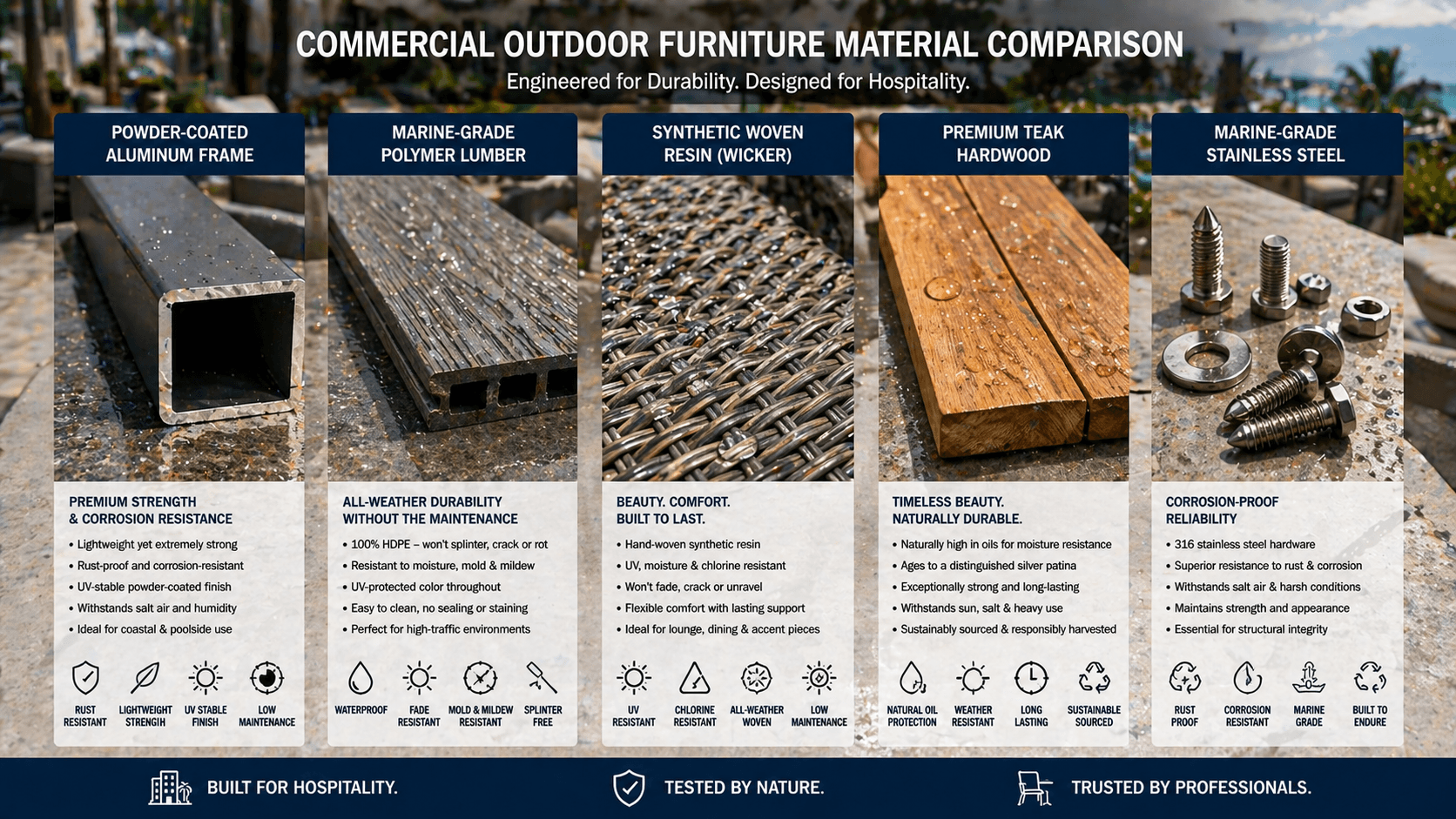
When selecting contract outdoor furniture, look beyond surface appearance. Evaluate how each material is built and treated. For contract-grade outdoor furniture for resorts, where sun, humidity, and salt exposure are constant, these details directly affect performance.
Aluminum (Marine-Grade 6000 Series)
Marine-grade aluminum is widely used in contract grade furniture for its strength and corrosion resistance. It performs well in poolside and coastal settings because it does not rust and maintains structural integrity over time.
What to verify:
Powder coating thickness (measured in microns)
Full weld construction instead of spot welds
Finish adhesion quality
Teak and Hardwoods
Teak is valued for its density and natural oil content. These properties help it resist moisture and environmental wear.
For commercial use, only A-grade teak should be considered. Joinery also matters. Mortise and tenon construction provides better long-term stability than basic screw assembly.
With proper care, teak furniture can last 5 to 10 years or more in outdoor hospitality environments.
Synthetic Wicker / HDPE Resin
High-quality synthetic wicker uses HDPE with built-in UV stabilizers. This helps resist fading, cracking, and brittleness over time. The internal frame, usually aluminum, determines overall strength.
Key factors:
UV testing ratings, often 2,000 hours or more
Consistent weave tension
Reinforced internal frame
Stainless Steel (304 vs 316)
Stainless steel provides strong structural support with a clean, modern finish.
316 stainless steel is suited for coastal environments due to higher resistance to salt corrosion
304 stainless steel works for inland applications
Powder coating can add protection and improve finish consistency.
Concrete and Stone
Concrete and stone provide durability and stability. They work well in high-wind areas where lighter furniture may move.
Their weight requires planning. This is critical for rooftop terraces or elevated decks. Always verify structural load capacity before installation.
What to Check on a Contract Grade Spec Sheet?
Understanding materials is only part of the process. The next step is reviewing the spec sheet, where performance details are defined. For any contract grade furniture, this is where you confirm if a product meets hospitality demands.
Core Specifications
Start with the fundamentals:
Weight capacity per piece: typically 300 to 500 lbs
UV resistance: measured in testing hours
Warranty structure: clearly separated for frame, finish, and fabric
A detailed spec sheet is a strong indicator of a reliable product.
Functional Features
Daily use requires practical features:
Stackability for efficient storage
Glide feet to protect surfaces and reduce noise
Textured powder coat finishes, which hide wear better than smooth finishes
These features support long-term usability and maintenance.
Certifications and Compliance
Look for recognized standards that confirm testing:
BIFMA: structural performance
CA117: fire safety for cushions
GREENGUARD: indoor air quality, relevant for mixed-use spaces
These certifications confirm that the furniture meets defined testing standards.
Quick Buyer Checklist
Before finalizing a selection, confirm:
Verified weight capacity
Documented UV testing results
Separate warranties for frame, finish, and fabric
Evidence of testing or certification
Availability of replacement parts
This checklist keeps the focus on performance, not appearance.
Evaluating Contract Grade Suppliers for Hospitality Projects
The quality of the supplier is just as important as the product itself. Reliable hospitality contract furniture depends on consistent production, clear communication, and long-term support.
Logistics and Ordering
Understand the practical side of ordering:
Minimum order quantities (MOQ)
Lead times for custom vs ready stock
Availability of faster options like /quick-ship-outdoor-furniture/
Clear timelines help keep projects on schedule.
Sampling and Testing
Whenever possible, request samples before placing a large order.
Physical samples allow you to evaluate:
Comfort and proportions
Material feel and finish
Build quality under real conditions
For larger projects, mock-ups can help ensure alignment with design intent.
Track Record and References
Look for suppliers with experience in projects similar to yours:
Resorts and hotels
Restaurant patios
Large-scale commercial installations
This helps confirm their ability to deliver consistently at scale.
After-Sales Support
Long-term performance depends on what happens after installation.
Check:
Availability of replacement parts
Warranty claim process
Clear documentation, such as /outdoor-furniture-warranty/
Reliable support reduces downtime and extends product life.
Customization Capabilities
Many hospitality projects require customization:
COM (customer’s own material) fabrics
Custom powder coat finishes
Branding or design alignment
A flexible supplier can adapt to your project’s specific requirements.
Closing Thoughts
Contract grade outdoor furniture is not just a label. It is a specification standard that defines performance under continuous commercial use. For hotels, resorts, and hospitality properties, specifying correctly from the start reduces replacement costs and operational disruption.
Before making a decision, request spec sheets, compare suppliers, and verify performance data. Use the checklist above to guide evaluation. Focus on measurable standards, not catalog images.
At Kingmake Outdoor, this approach guides how projects are specified and evaluated for long-term performance. This leads to more reliable installations across any outdoor space.
Frequently Asked Questions

What does contract grade mean in outdoor furniture?
Contract grade outdoor furniture is designed and tested for continuous commercial use, not residential use. It includes higher weight capacities, usually 300 to 500 lbs per seat, stronger frames, and finishes tested for UV exposure. Because the term is not regulated, verify performance through spec sheets and certifications such as BIFMA.
Is contract grade furniture better than regular outdoor furniture?
In hospitality environments, contract grade furniture is built for continuous use. Residential furniture may last 1 to 3 years in commercial settings, while contract grade options are designed to perform for 5 to 10 years or more. The difference shows in durability and reliability.
What materials are used in contract grade outdoor furniture?
Common materials include marine-grade aluminum from the 6000 series, A-grade teak, HDPE synthetic wicker, and stainless steel in grades 304 or 316. These materials provide strength, weather resistance, and long-term stability. Internal frame construction is as important as the surface material.
How long should contract grade outdoor furniture last?
In most hospitality settings, contract grade furniture lasts 5 to 10 years or more, depending on material and environment. Aluminum and teak perform well in poolside or beachfront conditions when maintained. Regular cleaning helps extend lifespan.
What is the difference between contract grade and commercial grade outdoor furniture?
Commercial grade is a broad term that varies by supplier. Contract grade furniture refers to products with tested, specification-based performance. These include verified weight ratings, UV testing data, and certifications, making them easier to compare and more reliable.

 Whatsapp
 sales@cnkingmake.com
 +8613925925021